
Why Credit Card Debt Became Such a Big Deal by 2025
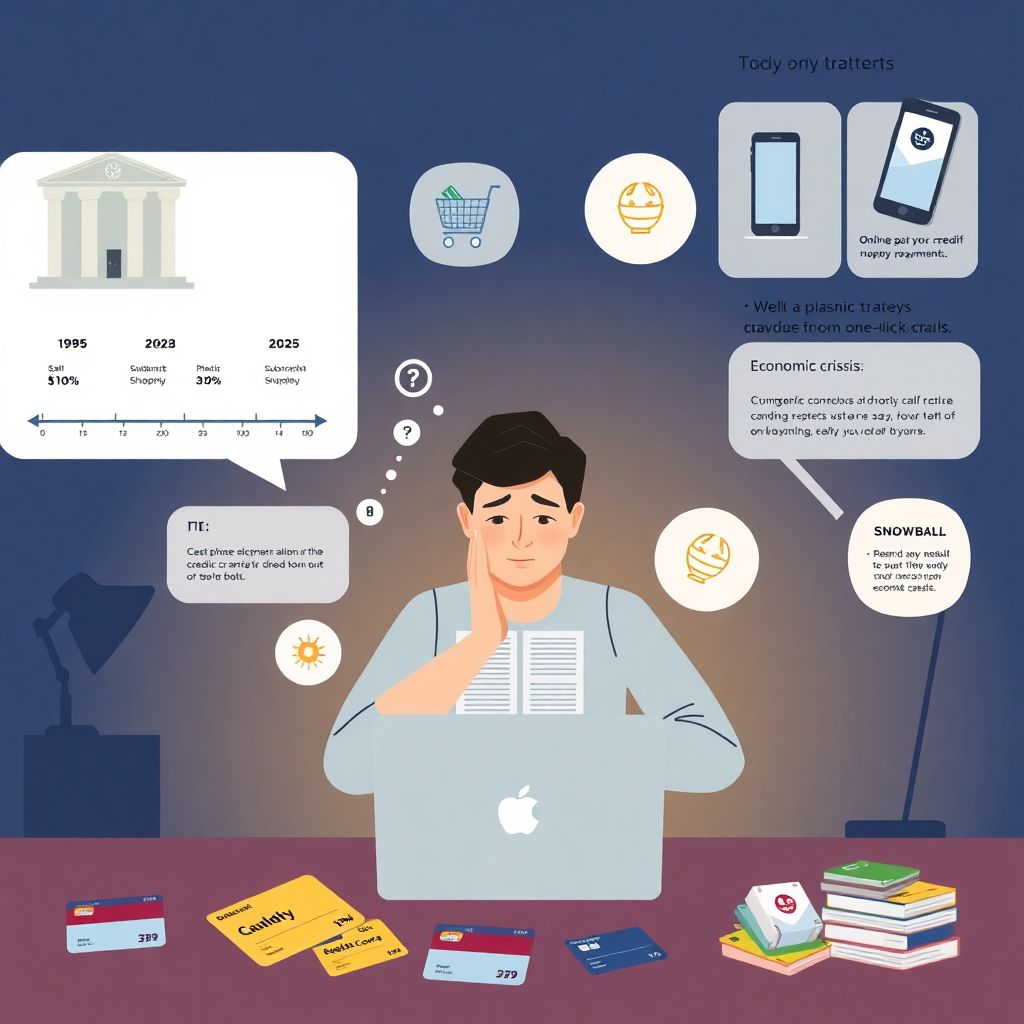
If you feel overwhelmed by credit cards, it’s not just “bad self-control.” By 2025, consumer credit card use sits on top of several decades of changes. In the 1980s and 1990s, banks aggressively pushed plastic to the middle class, rewiring daily spending from cash to revolving credit. Then came online shopping, subscription services, and one‑click payments that quietly spread balances across multiple cards. Add to that two big shocks — the 2008 crisis and the pandemic years — and you’ve got millions using credit cards as an unofficial emergency fund. Understanding this history matters: your situation isn’t a moral failing, it’s the predictable outcome of a system designed to keep you revolving, not repaying.
Diagnosing the Real Problem, Not Just the Balance
Case Study: Anna’s “Invisible” Interest Trap

Anna, a 33‑year‑old designer, thought she “only” had about $4,000 in debt. On paper that was true. But when we walked through her statements, the problem wasn’t the number, it was the structure: four cards, all with different closing dates, interest rates from 18% to 29%, and minimum payments that fell on awkward days between paychecks. She kept paying “whatever I can this month,” but almost never hit the statement balance on the highest‑rate card. Over three years she spent more on interest than on the original purchases and couldn’t explain where the money had gone. The real issue was chaos: no system, no hierarchy, and no calendar that matched her cash flow.
How to Turn a Mess into a Map
Before you even think about how to pay off credit card debt fast, you need a brutally honest inventory. One evening, sit down with every statement or app and write three numbers for each card: interest rate, current balance, and minimum payment. Then add a fourth: the day the payment actually leaves your bank. People often discover they’re paying on the wrong day, causing mini cash crunches and late fees. The mental shift is simple but powerful: your goal is no longer “make it disappear somehow,” but “decide, in advance, what every dollar will attack first.” Once you have that map, the strategies below start to work much faster.
Classic Strategies – And How to Make Them Actually Work
Avalanche, Snowball, and a Hybrid That Fits Real Lives

You’ve probably heard of paying down the highest interest card first (avalanche) or the smallest balance first (snowball). In theory, avalanche wins mathematically; in real life, motivation matters. A practical approach is a hybrid: line cards up by interest rate, then focus extra payments on the smallest balance among the high‑rate cards. That way, you still get quick emotional wins, but you’re not wasting money on low‑rate debt. The key is to lock this in as a fixed rule for yourself, like a policy at your own “personal finance company,” not a feeling you renegotiate every payday when you’re tired or stressed.
Non‑Obvious Adjustment: Rewrite Your Minimums
Here’s a less obvious trick: create your own minimum payments that are higher than the bank’s, and never go below them. For example, if the official minimums total $220, reset your personal minimum to $260 or $300, and treat that as non‑negotiable, like rent. The extra $40–$80 is small enough not to freak you out, but over a year it shaves months off your payoff timeline. Another subtle move: pay your main card twice a month — a chunk on payday, and a small “booster” right after the statement closes. This reduces the average daily balance, quietly cutting interest even if you don’t change how much you pay overall.
When to Use Balance Transfers and Consolidation
The Smart Way to Use 0% Offers
By 2025, banks have turned promotional offers into bait, and the best balance transfer credit cards are advertised everywhere — but they only help if you treat them like a scalpel, not a lifestyle upgrade. A balance transfer makes sense when three conditions line up: your credit score is still decent, you can afford to pay enough monthly to clear the transferred balance before the promo expires, and you’re ready to stop using the old card entirely. The trap is paying a transfer fee, then continuing to swipe on the original card, ending up with two active balances instead of one.
credit card debt consolidation Without Shooting Yourself in the Foot
credit card debt consolidation can be a lifesaver or a slow‑motion disaster. Rolling several cards into one personal loan at a lower fixed rate can simplify life and often cut interest, but only if you change the behavior that created the balances. Real‑world example: Michael consolidated $12,000 into a five‑year loan. His monthly payment dropped, which felt great — so he quietly went back to using his cards “for points.” Two years later he owed $7,000 on the loan and another $5,000 spread across three cards. The pro move after consolidation is radical: close or freeze all but one low‑limit card for emergencies and online payments, and set a written rule for that card: it must be paid in full every month, no exceptions.
Alternative Methods People Rarely Talk About
Using Automation and “Friction” as Financial Guardrails
Not every solution is about negotiating interest rates. Sometimes you just need to outsmart your own impulses. One alternative method is building “friction.” Instead of keeping all cards in your wallet, lock the higher‑rate ones in a drawer, and delete them from online stores and digital wallets. You don’t need to cut them up; you just make it annoying to use them. Pair that with automatic payments the day after payday, scheduled from your checking account. That way, you never see the money as “available,” and you’re less likely to sabotage yourself on a rough day when work was bad and a flash sale looks comforting.
Leveraging Temporary Income Spikes Without Burning Out
Side hustles and overtime are common advice, but they often lead to burnout and then rebound spending. A more sustainable twist is to treat any temporary income spike — a freelance project, a tax refund, a bonus — as a “debt bomb.” Before the money arrives, decide which specific card and which specific dollar amount it will kill. Then, when the cash hits, execute immediately, without parking it in checking where it blends into your general funds. This pre‑commitment mindset protects you from the “I deserve a treat” narrative that usually dissolves half the benefit before you ever log in to your banking app.
Professional‑Level Tactics and Hidden Resources
Where credit counseling Services Actually Help
Many people imagine credit counseling services for credit card debt as something only for people on the brink of bankruptcy. In reality, reputable non‑profit agencies can step in much earlier. They can sometimes negotiate lower interest rates or structured payment plans directly with card issuers, bundled into a single monthly payment. You still repay what you owe, but with more predictable terms and fewer late‑fee landmines. The catch: you must be ready to stop using the cards included in the plan. That sounds scary, yet for many clients it’s a relief — the decision to stop is made once, upfront, instead of being a daily willpower battle.
When Debt Relief Programs Are a Last Resort
You’ve probably seen ads for credit card debt relief programs promising “pennies on the dollar.” These are different from counseling: they typically involve stopping payments, letting accounts go delinquent, and then trying to settle for less than the full balance. This can work in extreme hardship, but it comes with bruised credit for years, collection calls, and possible tax implications on forgiven amounts. Think of this as an emergency exit, not a shortcut. Before you even consider it, squeeze every conventional option: rate negotiations, balance transfers, budget cuts, small but consistent extra payments, and side income aligned with your skills rather than random burnout‑inducing gigs.
Real‑World Hacks From People Who Got Out
The “Rent First, Cards Second” Budget Flip
One professional‑grade lifehack many successful pay‑off stories share is flipping how they think about fixed and variable expenses. Instead of starting with lifestyle (food, fun, subscriptions) and seeing “what’s left” for cards, they define a strict core: housing, utilities, basic food, transportation, essential insurance, and a committed debt payment. Everything else becomes negotiable. One IT consultant I worked with put his debt payment in the same mental category as rent. Missed restaurant dinners, yes; missed card payment, no. Within 18 months he cleared $9,000 without a dramatic salary jump — the difference was the order of priorities, not superhuman discipline.
The “One‑Month Lag” That Breaks the Paycheck‑to‑Paycheck Cycle
A more advanced tactic is building a one‑month cash buffer before attacking debt aggressively. It feels counterintuitive: why save while you owe 22% interest? But for many, the paycheck‑to‑paycheck treadmill is exactly what keeps balances from shrinking. The one‑month lag works like this: you slowly build up enough cash so that all of February’s expenses are paid with January’s income. Once you’re always paying this month’s bills with last month’s money, emergencies stop going straight to plastic, and your debt payment plan stops getting derailed by every flat tire or medical copay. The progress is slower at first, then suddenly much faster and far more stable.
Bringing It All Together in 2025
By 2025, managing credit cards effectively isn’t about finding a magic app or a genius spreadsheet; it’s about understanding the game you’re in and changing the rules for yourself. The tools — balance transfers, credit card debt relief programs, consolidation loans, counseling, automation — are just tools. What really shifts the outcome is a simple sequence: map the problem clearly, choose a repayment strategy that fits your psychology, add non‑obvious safeguards like friction and pre‑commitment, and only then consider advanced options like credit card debt consolidation or the best balance transfer credit cards.
You don’t need to become a different person to get out of debt; you need a different system around the person you already are. Start with one card, one rule, and one concrete change this month. The history that brought you here doesn’t have to dictate the next chapter.