
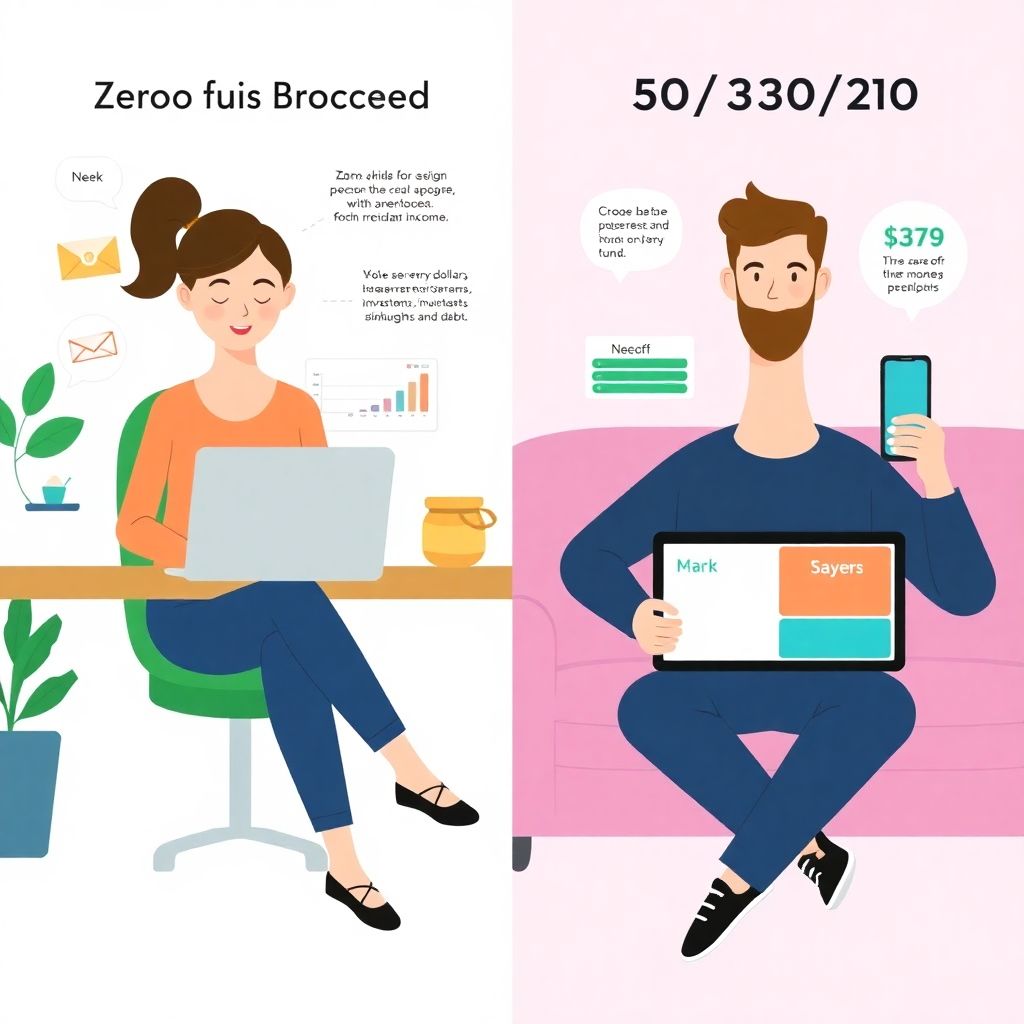
Zero-Based Budgeting vs 50/30/20: Why Your Money Personality Matters
Why budgeting methods feel so different
Two people can use the same “best budgeting method zero based vs 50 30 20” guide and get opposite results. It’s rarely about math; it’s about money personality: your tolerance for detail, impulse control, and how much structure you can live with month to month. Zero-Based Budgeting (ZBB) suits people who like granular control and predictability, while the 50/30/20 rule attracts those who prefer simple decision frameworks. If you ignore this fit and chase trends or influencers, you often end up with “perfect on paper, abandoned in real life” spreadsheets, and the illusion that you’re just “bad with money”, when in fact инструмент просто не соответствует вашему поведению.
How Zero-Based Budgeting really works in everyday life
In Zero-Based Budgeting, every dollar gets a job: income minus planned outflows must equal zero. That doesn’t mean you spend everything; it means you explicitly assign money to savings, investments, sinking funds and debt. In practice, a zero based budgeting app for personal finance forces you to confront trade‑offs: either that restaurant bill stays, or the extra loan payment disappears. This method exposes “hidden” priorities, like subscriptions you forgot about or casual food delivery. The upside is total clarity; the downside is cognitive load. You must touch the budget frequently, especially when income is variable or when unexpected costs arrive mid‑month.
Real case: when Zero-Based Budgeting is a lifesaver
Case: Anna, 32, freelance designer with chaotic income. For years she used rough mental math: “as long as there’s money in the account, I’m okay.” Tax season blew that illusion apart: she owed thousands she hadn’t reserved. Switching to ZBB, she started assigning a fixed percentage of every invoice to tax, irregular expenses, and savings on day one. Within six months, she not only cleared her tax backlog, but also built a three‑month emergency fund. For her, the structure of allocating each payment immediately transformed anxiety into a routine. The price: more time at the keyboard every week — about 30 minutes after each invoice batch.
Limits of Zero-Based Budgeting that nobody likes to admit
ZBB is often sold as a universal silver bullet, but it breaks down for some personalities. If you’re prone to perfectionism, you can end up endlessly tweaking categories instead of making actual financial decisions. Couples with very different spending styles sometimes turn ZBB into a battlefield: every line item becomes a negotiation. There’s also an illusion of certainty; just because every euro is planned doesn’t mean your assumptions are realistic. Without frequent post‑mortems — comparing plan to reality and adjusting baselines — Zero-Based Budgeting degenerates into ritualistic data entry that looks responsible but doesn’t really change savings rates or debt payoff speed.
50/30/20: The Lightweight Framework
Core idea and why it feels so easy
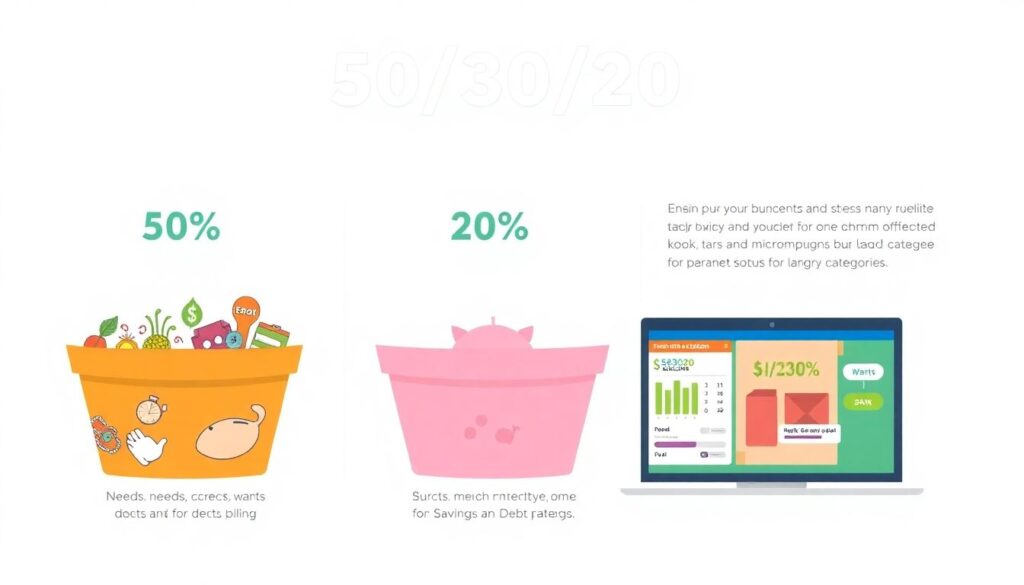
The 50/30/20 rule says: 50% of net income for needs, 30% for wants, 20% for savings and debt. Instead of micromanaging dozens of categories, you think in three buckets. A 50 30 20 budget calculator online lets you plug in your income and see instant targets for each block. Psychologically, this reduces friction: fewer decisions, clearer guardrails. It’s closer to “financial training wheels” than a detailed system. If you hate tracking receipts but want a sanity check, 50/30/20 sets rough boundaries that prevent lifestyle creep. However, it assumes your fixed costs fit into 50%, which is unrealistic in high‑rent cities or when you carry heavy mandatory payments.
Real case: when 50/30/20 beats detailed tracking
Case: Mark, 27, junior developer, stable salary, no debt. He tried ZBB for three months and burned out: the constant category tweaking felt like an extra job. Switching to 50/30/20, he only monitored three ratios once a month. He automated payments so that 20% left his checking account the day after payday into investments and savings. Within a year, his net worth grew steadily, even though he stayed pretty relaxed about day‑to‑day spending. The method worked because his income was predictable, his fixed costs were modest, and he valued simplicity over optimization. That “good enough” match mattered more than theoretical efficiency.
Hidden weaknesses of the 50/30/20 rule
The biggest problem with 50/30/20 is its bluntness. If your “needs” already consume 70% of income, this framework can make you feel like a perpetual failure instead of highlighting structural issues like housing or car costs. For high earners, 30% for wants may be far more than they truly value, leading to inflated discretionary spending just because the rule “allows” it. Also, it doesn’t distinguish between short‑term savings (vacation fund) and long‑term capital building (retirement, investments). Without extra layers — like specific savings targets and timelines — you may respect the ratios but still undershoot what you really need for financial independence.
Comparing Methods Through Money Personality
How to choose the right budgeting method for me
Instead of asking “Which is the best in theory?”, start from behavior. Diagnose three traits: 1) Need for control: do you feel safer with detailed plans or high‑level guardrails? 2) Consistency: can you touch your numbers twice a week, or realistically once a month? 3) Complexity tolerance: does granular data motivate or exhaust you? If you crave precision, handle irregular income, and don’t mind frequent check‑ins, ZBB fits. If you prefer minimal maintenance and your cash flow is stable, 50/30/20 is more sustainable. The method that matches your psychological bandwidth is the one you’ll still be using in two years.
Non-obvious hybrid solutions
You don’t have to be monogamous with methods. Many advanced users run a hybrid: Zero-Based Budgeting for “macro” allocations right after payday, then 50/30/20 as a monthly health check. One non‑obvious approach: ZBB only for volatile or risky zones — dining out, subscriptions, side‑gig income — while letting stable bills sit under a simple 50% cap. Another trick: apply ZBB just to your savings bucket, splitting that 20% (or more) into precise goals like investments, emergency fund, and education. This preserves control where it matters most — capital building — without forcing you to log every coffee or bus ticket.
Alternative Methods You Shouldn’t Ignore
Envelope system and pay-yourself-first
Beyond the two popular frameworks, there are analog and behavioral options. The envelope method, whether physical cash or digital “spaces,” predates Zero-Based Budgeting but uses similar logic: you pre‑limit categories and stop spending when the envelope is empty. It’s powerful for people who overspend on specific triggers like groceries or entertainment. The pay‑yourself‑first method is even simpler: you automate transfers to savings and investments right after payday and treat what remains as your true disposable income. It doesn’t care how you slice day‑to‑day spending, which suits those who only want to engineer a higher savings rate without granular oversight.
Percentage-based and goal-driven budgeting
Some professionals mix percentage‑based rules with explicit goals. For example, they might start with a 60/20/20 scheme (needs/wants/investments) and adjust weights annually as income grows. Goal‑driven budgeting reverses the usual logic: you define numerical goals (buying a home in five years, or retiring at 55), calculate required monthly contributions, and then back‑solve the rest of the budget around those constraints. This method is unforgiving: if the math doesn’t fit, it forces you to re‑think lifestyle, timelines, or income. It’s particularly useful for people with strong long‑term orientation who see money mainly as a tool for achieving clearly quantified outcomes.
Pro-Level Tips and Non-Obvious Hacks
Professional-level budgeting hacks
For those who treat personal finance almost like running a small firm, a few tactics stand out. First, separate “operating accounts” from “strategy accounts”: daily spending lives in one place, long‑term reserves and investments in another, minimizing accidental leakage. Second, implement monthly variance analysis like in corporate budgeting: compare actuals to plan, investigate deviations over a certain threshold, and update assumptions. Third, time‑box your budgeting work: one 60‑minute “board meeting” per month, plus two 15‑minute check‑ins a week. This keeps even Zero-Based Budgeting from expanding to fill all free time and aligns routine actions with a structured decision cycle.
Learning curve and when to get external help

If you constantly bounce between methods, consider a short, structured budgeting course to improve money management skills instead of another app experiment. A good program will address behavioral triggers, not just spreadsheets, and help you map methods to your personality and goals. In some cases, a financial coach can watch your data and call out patterns you’re blind to, like chronic over‑commitment to savings that later leads to “revenge spending.” Ultimately, the right question isn’t “Which framework is best?” but “Which system can I automate, understand under stress, and keep using through job changes, crises, and major life events?”
Practical Roadmap to Decide and Start
Step-by-step way to test what fits
To make this actionable, run a three‑month experiment:
1. Month 1: Track all spending passively using any app, without forcing a method. Just collect data and note emotional reactions.
2. Month 2: Apply Zero-Based Budgeting once, then implement weekly check‑ins. Observe stress level and actual adherence.
3. Month 3: Switch to 50/30/20 using your real data; adjust percentages if 50% for needs is impossible, and compare results.
At the end, measure: savings rate, time spent, and emotional friction. Choose the method — or hybrid — that gives the best balance of control, simplicity, and sustainability, not just the prettiest spreadsheet.