
Why Tight-Month Budgeting Matters Right Now
Over the last few years, the “tight month” stopped being an exception and quietly turned into a routine for millions. According to the Federal Reserve’s 2023 report, about 37–40% of U.S. adults said they would struggle to cover a $400 emergency without borrowing or selling something, and similar numbers held steady from 2021 through 2023. Inflation in 2022–2023 made groceries, rent and utilities bite harder, while wages grew slower for many low‑ and middle‑income workers. So the question is no longer whether to budget, but how to make a realistic plan when the paycheck barely stretches to the end of the month.
From Envelopes to Apps: A Short Historical Detour
How People Used to Survive a Tight Month
Before spreadsheets and apps, families relied on cash envelopes, notebooks and strict social norms around thrift. In the mid‑20th century, a common approach was to divide wages into physical envelopes labeled “rent”, “food”, “transport” and “savings”. That primitive monthly budget planner for tight budget households wasn’t romantic; it was a simple control system in a world where credit was limited. Studies of household economics from the 1960s–1980s show that low‑income families often kept surprisingly detailed records exactly because a single mistake meant going hungry until payday.
Digital Shift and the Rise of Micro‑Budgeting
From the late 2000s onward, online banking and smartphones changed the landscape. Automatic notifications, instant balance checks and cheap card payments made cash envelopes feel outdated, yet the underlying logic stayed the same. After the COVID‑19 shock in 2020, downloads of personal finance apps for budgeting and saving jumped sharply: analytical firms reported double‑digit growth in 2021–2022 as people looked for simple ways to track every dollar. By 2023, more than half of U.S. adults used at least one financial app, and the conversation shifted from “should I budget?” to “how do I keep it so simple I’ll actually stick to it during a tight month?”
Basic Principles: What Actually Works When Money Is Short
Start with Reality, Not with Ideals
When you’re trying to figure out how to budget money on a low income, the first step isn’t downloading a shiny tool, it’s getting brutally honest about what already happens. That means pulling bank and card statements for the last two or three months and grouping expenses into broad categories: housing, food, transport, debt, health, and “everything else”. Research from 2022–2023 consistently shows that people underestimate small daily spending by 20–30%. Once you see the full picture, you can set a one‑month survival budget that focuses on keeping a roof over your head, the lights on and food on the table, while trimming non‑essentials for just this tight stretch.
Priorities, Not Perfection
Any realistic plan for a rough month is built on priority tiers: must‑pay, should‑pay, nice‑to‑have. Housing, utilities, basic food and essential medications go into the first tier. Minimum payments on debts and necessary transport fall into the second. Streaming services, online shopping and impulse food delivery go into the third. During 2022–2024, delinquency rates on credit cards in many countries ticked up, partly because people delayed basic bills to keep lifestyle comforts. Swapping that logic around can feel emotionally hard, but financially it’s safer to cut variable pleasures than to risk eviction, disconnection fees or late charges that snowball into next month.
Short Horizon, Clear Rules
When money is tight, thinking in 12‑month goals can feel useless. It’s more practical to use a weekly or bi‑weekly planning cycle that matches your pay schedule. Set a simple rule: every time money comes in, you instantly assign it to categories before spending a cent. Behavioral studies from 2021–2023 show that “pre‑deciding” boosts follow‑through because you’re making choices in a cold state, not while tired and hungry after work. A tight‑month budget doesn’t need 20 categories; five to eight is usually enough to steer your spending and tell you, in plain language, when you’re about to overshoot.
Practical Tricks: Turning Principles into Daily Habits
Mini Envelopes in a Digital World
You can still use the old envelope system even if you’re mostly cashless. Many banks now let you create sub‑accounts or “spaces” for different goals. For a cash‑strapped month, you might have “Rent”, “Bills”, “Groceries” and “Transport”. As soon as your paycheck arrives, you slice it into these buckets. This simple structure beats most “best budgeting tips for living paycheck to paycheck” lists because it forces you to see trade‑offs. If groceries are almost empty by the 20th, you know you must either move money out of a different bucket consciously or change the menu, instead of drifting into overdraft by accident.
Use Tech, but Keep It Dumb and Simple
Fancy tools are optional, but simple automation can protect you from yourself on stressful days. Link your main account to one or two carefully chosen personal finance apps for budgeting and saving, not ten. Turn on alerts for low balances and large transactions, and schedule automatic transfers to your “Rent” or “Bills” buckets right after payday. Data from 2022–2023 show that people who automate even one or two bill payments have fewer late fees and overdraft charges. The goal is not to micromanage every coffee, but to make sure the big, immovable expenses get covered before anything else slips through.
Quick Wins: Shrinking the Pain Points
There are plenty of ways to save money on a tight budget that don’t require extreme deprivation. Food is often the biggest swing factor. Swapping two takeaway meals a week for home‑cooked versions can easily free up $80–100 a month in many cities, based on average price data from 2022–2024. Another lever is subscriptions: surveys in 2023 found that the average U.S. user underestimated subscription spending by more than 25%. During a tight month, temporarily pausing two or three non‑essential services is a fast, low‑friction move that immediately releases cash without altering your long‑term plans.
Building a “Micro Cushion” Even in a Rough Month
It sounds unrealistic, but even in a tight month it helps to create a tiny buffer. Think of it as an “oops” fund. Set the bar low: maybe it’s $5–10 per week, rounded up from small card payments or skimmed from discounted groceries. Several neobanks and apps introduced round‑up features in 2021–2024, and internal data they’ve reported suggest users barely notice the difference in daily life but end up with meaningful small cushions in a few months. You probably won’t build a full emergency fund during a crisis month, but you can at least soften the blow of the next surprise expense.
Real-Life Implementations: What It Looks Like Day to Day
A Tight-Month Plan for a Single Renter
Imagine you earn just enough that every spike in prices hurts. You map your last two months of spending and notice that food delivery, rideshares and random chemist runs quietly swallow $250–300. For this particular tight month, you decide on a strict ceiling: a fixed grocery budget, no rideshares unless it’s unsafe to walk, and one pre‑planned takeaway night. You set up a simple weekly check‑in: five minutes on Sunday to see where you stand. In survey data from 2022–2023, people who did even minimal weekly reviews were much more likely to stick to their plans than those who avoided looking at their balances.
Family on One Income for a Month

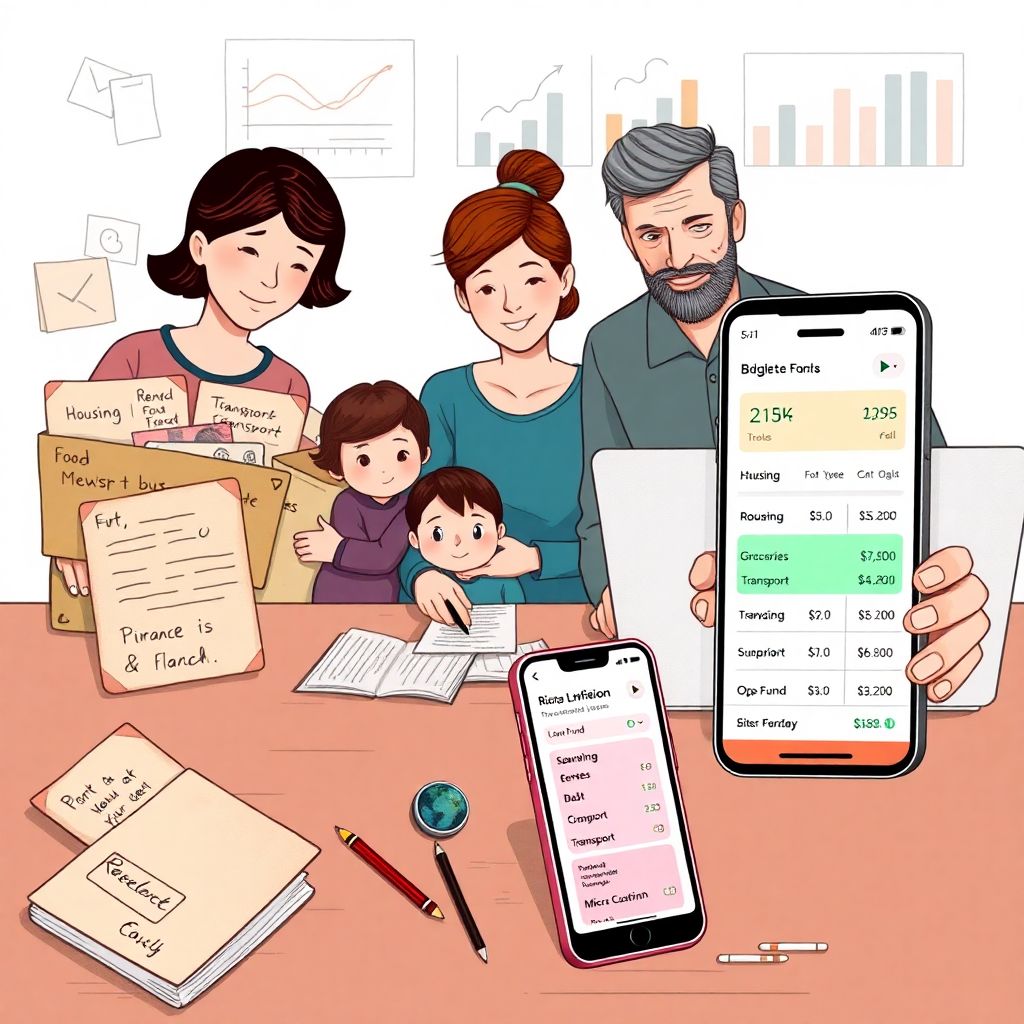
Now picture a family where one partner’s hours were cut in 2023, a scenario that labour statistics showed for millions after various economic shocks. Their income drops by 25% for a few months, pushing them close to the edge. Together they build a stripped‑down one‑page plan: mortgage, utilities, basic groceries, school costs and fuel are funded first. Streaming and non‑essential shopping are paused; any unexpected money, like refunds or small side gigs, goes into a “buffer” jar. This isn’t glamorous, but it’s effective: instead of relying on credit cards and facing high‑interest debt, they protect core bills and exit the tight stretch with less financial hangover.
Using a Planner without Overcomplicating It
Many people buy a fancy monthly budget planner for tight budget seasons and then abandon it after a week because it feels like homework. The trick is to reduce the workload. Instead of tracking every cent, track only the categories that regularly blow up: maybe groceries, transport and spontaneous treats. Set realistic caps and a specific day to adjust them if life changes mid‑month. Research on habit formation published in 2021–2023 suggests small, easy routines beat perfect but complex systems. A cheap notebook or a simple note on your phone used consistently will outperform a detailed budget that lives in a drawer.
Common Misconceptions That Quietly Sabotage You
“I’m Too Broke to Budget”
One of the most persistent myths is that budgeting only makes sense once you earn “enough”. In reality, the lower the income, the more damaging every unplanned dollar becomes. Studies of low‑income households from 2021–2023 show that those with even a rough written plan had fewer missed bills and less reliance on high‑cost credit than those who “winged it”. Budgeting doesn’t magically increase your paycheck, but it does reduce waste, late fees and panic purchases. Even if there’s almost nothing left after essentials, you still benefit from knowing that fact clearly instead of discovering it too late.
“Small Expenses Don’t Matter”
Another misconception is that only big costs deserve attention, so it’s pointless to rethink snacks, rideshares or streaming bundles. Yet transaction‑level data from banks in 2022–2024 repeatedly show that aggregated “small” spending often rivals major bills. Ten or fifteen dollars here and there doesn’t feel like much in the moment, but over a month it may equal half your grocery budget. This doesn’t mean you must cut all small pleasures; it means consciously choosing a few you truly value and trimming the rest. In a tight month, precision with small leaks can be the difference between staying solvent and dipping into debt.
“Apps or Spreadsheets Will Fix Everything”
Finally, people often assume tools are the solution: if they could just find the right app, their money problems would vanish. In reality, digital tools are amplifiers, not saviours. They make good habits easier and bad habits faster. Even the best budgeting tips for living paycheck to paycheck fall flat if you never open the app or ignore alerts. Pick one simple tool you actually like using—a spreadsheet, a notebook or a basic app—and tie it to a fixed routine, like checking it with your first coffee on Saturday. Consistency beats features, especially when every dollar is already spoken for.
Looking Ahead: Making Tight Months Less Scary
While I don’t have full statistics for 2025 yet, the trend from 2022–2024 is clear: many households are still one or two shocks away from serious trouble, but small, steady budgeting habits do move the needle. Tight‑month planning isn’t about becoming a finance guru; it’s about staying calm when the numbers look ugly and giving every dollar a job before it disappears. If you keep your system simple, review it regularly and adjust when life changes, each tough month becomes slightly more manageable—and over time, that’s what opens the door from constant firefighting to real financial breathing room.