
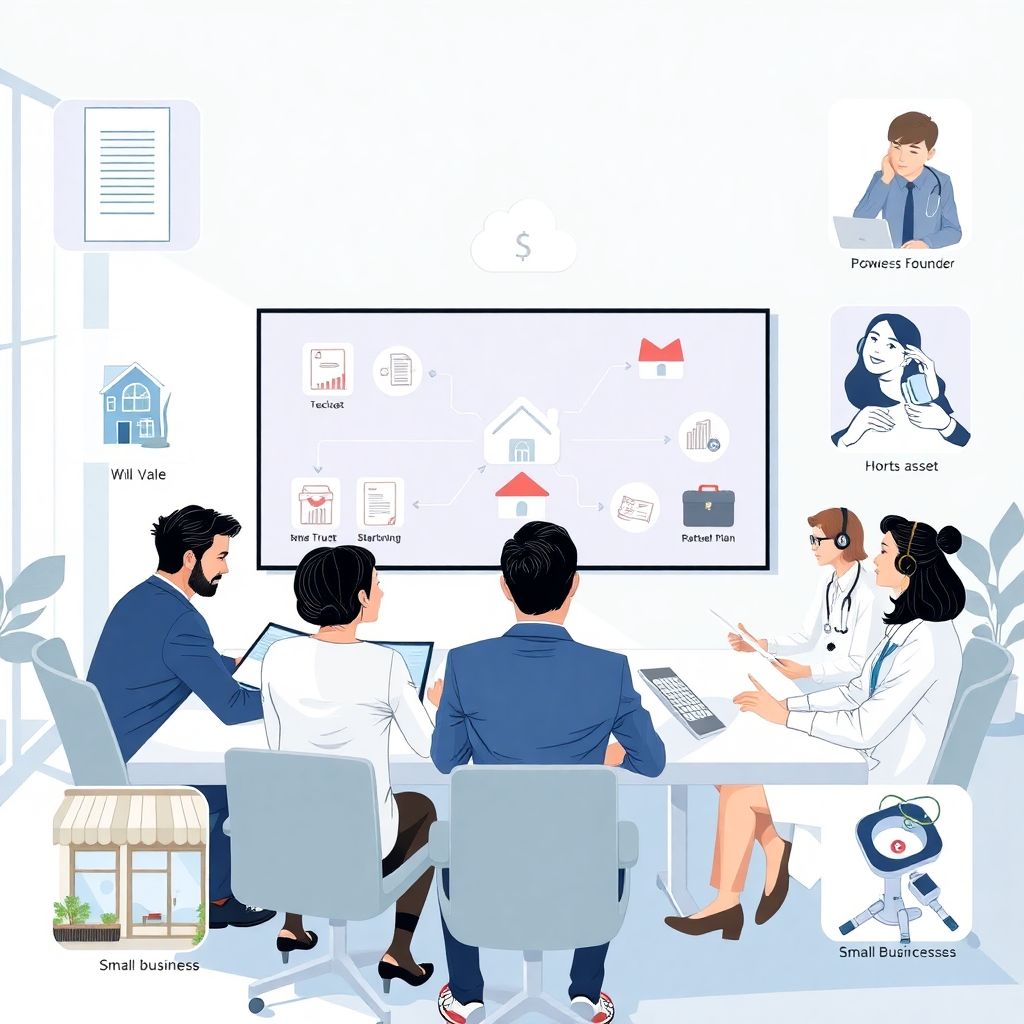
Why Estate Planning Has Become a “Now, Not Later” Task
Estate planning used to be something people associated with retirement, grey hair, and stacks of paper in a mahogany-paneled office. In 2025, that picture is badly outdated. High earners in their 30s and 40s, tech founders, freelancers with global income, and even remote workers with stock options all face complex financial lives much earlier than previous generations.
Yet behavior hasn’t fully caught up. Surveys in 2023–2024 repeatedly showed that roughly 60–70% of adults in the U.S. still don’t have even a basic will, and the numbers are worse among people under 45, despite rising incomes and asset values. For busy people, the gap between *financial complexity* and *legal preparedness* is widening fast—and that gap has real economic consequences for families, businesses, and the broader financial system.
—
From Medieval Wills to Digital Vaults: A Short History of Estate Planning
Wills are not new. They’re one of the oldest legal tools we have:
– In ancient Rome, written wills were already regulating family inheritance.
– In medieval Europe, landowners used wills and early forms of trusts to control which heirs received property and when.
– By the late 19th and early 20th centuries, industrial wealth and corporate ownership made trusts popular among business families who wanted to separate ownership from direct control.
The real acceleration, though, came after World War II. The postwar middle class started buying homes, investing in retirement accounts, and building small businesses. Estate planning moved from a niche concern of the ultra-wealthy to a mainstream financial task.
Fast forward to the 2000s and 2010s: online banking, discount brokerages, and global careers made personal balance sheets more complicated. Then came the COVID-19 pandemic, which pushed estate planning online almost overnight—remote signings, video consultations, and the first mainstream, *affordable estate planning services online*.
By 2025, the “traditional” process—waiting weeks for in‑person meetings, printing 60-page documents, storing them in a filing cabinet—looks increasingly out of step with how busy professionals live and work.
—
The Core Building Blocks: What Busy People Actually Need
Wills: Still the Foundation, Just Faster and Smarter
A will is still the cornerstone of estate planning. It:
– Says who gets what (assets, personal property, digital assets).
– Names guardians for minor children.
– Appoints an executor to manage the estate.
For a time-poor professional, a will has to be both *clear* and *easy to maintain*. The old pattern of “sign once at 45 and never touch again” simply doesn’t work when your life changes every two or three years—promotions, new equity grants, business interests, cross-border moves.
Trusts: Control, Privacy, and Time Savings for Your Heirs
Trusts used to be a tool mainly for the ultra-rich, but in the 2020s they’ve gone mainstream, particularly for:
– High-income dual-career households with kids.
– Business owners or partners in private companies.
– Professionals with real estate in multiple states or countries.
A well-designed *wills and trusts estate planning package* lets you bypass prolonged probate, add conditions (age-based distributions, incentive clauses), and preserve privacy. For busy people, this is almost a productivity tool for the next generation: it eliminates months or years of procedural friction for your heirs.
—
Estate Planning for High Income Professionals: Why Complexity Arrived Early
How Modern Careers Break the “Simple Estate” Assumption
The phrase *estate planning for high income professionals* used to evoke doctors and lawyers with predictable careers. In 2025, that group also includes:
– Tech and finance workers with stock options, RSUs, and carried interest.
– Remote employees with income and tax ties to multiple states (or countries).
– Creators, consultants, and startup founders with intellectual property and illiquid equity.
Each of these features adds:
– Tax layers (federal, state, sometimes international).
– Liquidity questions (how to pay estate taxes if most value is in illiquid shares).
– Succession issues (what happens if a founder dies mid-vesting or mid-exit).
Without planning, families often end up forced into hurried sales of assets, suboptimal tax outcomes, and prolonged legal processes—all because the documents didn’t anticipate the complexity of a 21st-century professional life.
Why Busy People Procrastinate—and What the Data Suggests
Even as income rises, completion rates for estate plans lag. Repeated surveys across 2020–2023 show three recurring reasons:
– “I’ve been meaning to, but I’m too busy.”
– “I don’t know where to start.”
– “I think I don’t have enough assets yet.”
The first is a time problem, the second is an information problem, and the third is often simply wrong once you consider life insurance, retirement accounts, and equity compensation. Yet all three indicate that the traditional, slow, opaque process is misaligned with how busy people make decisions: they need quick triage, clear priorities, and modular steps.
—
Statistics and Economic Stakes: Why This Isn’t Just a “Personal” Issue
The Hidden Macroeconomic Risk of Poor Planning
Estate planning isn’t just about family harmony; it has measurable economic effects:
– Billions of dollars of assets sit in limbo each year due to intestacy (dying without a will), contested estates, and unclaimed accounts.
– Administrative delays tie up capital that could otherwise be reinvested, donated, or used productively by heirs.
– For small and mid-sized businesses, lack of a succession plan can destroy jobs and local economic output when an owner dies unexpectedly.
In markets with aging populations, this problem magnifies. As baby boomers and Gen X transfer trillions in wealth over the coming decades, poor planning risks significant inefficiencies: forced sales of businesses, fire-sale liquidation of real estate, and higher legal and court costs.
What the Next Decade Likely Looks Like
Analysts expect three clear trends through the 2030s:
– Rising volume of transfers: More estates, more complex assets, more cross-border issues.
– Growing role of technology: Document automation, digital vaults, and AI-assisted reviews will handle much of the basic drafting.
– More regulatory attention: Governments are already eyeing inheritance taxes, information reporting, and transparency in cross-border holdings.
Taken together, the macro picture suggests that estate planning will shift from being a niche specialty to a core component of personal finance infrastructure—similar to how retirement planning moved from fringe to mainstream in the late 20th century.
—
Time Pressure and the Search for the Right Lawyer
“Estate Planning Lawyer Near Me” vs. the Right Fit
When busy people finally decide to act, they often start with a hurried search for an *estate planning lawyer near me*. That’s understandable, but “near” is not always the same as “right.”
For professionals with complex compensation or multi-jurisdictional issues, you need someone who:
– Understands your asset mix (equity, carried interest, multiple properties).
– Is comfortable working largely by video and secure portals.
– Offers a clear scope and fixed or predictable fees.
The legal industry has been adapting. Many firms now operate in hybrid models: initial consultations online, e-signatures where allowed, and coordinated planning with financial advisors and accountants. Geography matters less than specialization, responsiveness, and process design.
The Rise of the “Best Estate Planning Attorney for Busy Professionals”
We’re seeing a new micro‑specialty emerge: the *best estate planning attorney for busy professionals* is not just a technical expert; they’re also a process architect. They:
– Break planning into short, focused sessions.
– Use checklists, summaries, and visual diagrams.
– Leverage secure online questionnaires and digital storage.
This doesn’t replace judgment or nuance. Instead, it channels scarce attention: you spend your limited time on tradeoffs and priorities, not on deciphering jargon or chasing missing statements.
—
Online Platforms and the Shift in Industry Economics
Affordable Estate Planning Services Online: Boon or Risk?
The explosion of *affordable estate planning services online* has reshaped the entry-level market. Where a simple will once meant several in‑person meetings and a large bill, many busy people now complete a basic package in under an hour for a fraction of the old cost.
Benefits:
– Lower barrier to entry for first-time planners.
– Faster iterations as life changes.
– Digital storage and reminders built in.
Risks:
– One-size-fits-all templates that miss tax nuances.
– Inadequate customization for blended families or business interests.
– Overconfidence—people assume “I filled the form, I’m done,” without periodic review.
The likely pattern going forward is *hybridization*: online tools handle data gathering and standard clauses; attorneys handle edge cases, structure, and strategy. For the industry, this means margin compression at the low end but rising demand for sophisticated advice higher up the value chain.
Economic Aspects for Law Firms and Tech Providers

The economics of estate planning are evolving along three axes:
– Pricing models: Flat-fee packages replace hourly billing for standard documents; subscriptions emerge for ongoing updates and storage.
– Scale: Tech platforms can serve thousands of users with minimal marginal cost, while boutique firms focus on fewer, more complex clients.
– Partnerships: Integrations with financial advisors, tax professionals, and even payroll/HR systems (for equity data) create new distribution channels.
Firms that cling to purely analog, hourly models risk being outcompeted—not just on cost, but on convenience and response time, which are decisive factors for overcommitted professionals.
—
How Estate Planning Is Reshaping the Broader Financial Industry
Integration with Wealth Management and Fintech
By 2025, estate planning isn’t a standalone activity; it’s gradually fusing with broader financial planning:
– Robo-advisors and wealth platforms flag missing documents and suggest next steps.
– Employer platforms surface estate considerations when employees accept stock grants or deferred comp.
– Digital banks experiment with “in case of emergency” access protocols for trusted contacts.
For the financial services industry, this integration produces:
– Stickier client relationships (more services under one umbrella).
– New fee lines via bundled planning packages.
– Richer data on client life events, improving product design and risk management.
Regulatory and Compliance Ripple Effects
As digital tools proliferate, regulators are focusing on:
– Electronic wills and remote notarization standards.
– Data privacy and security for sensitive documents.
– Cross-border recognition of digital signatures and cloud-stored records.
This regulatory attention will likely standardize some aspects of the process, reducing friction, but it may also raise compliance costs for smaller providers. Over time, larger, well-capitalized platforms and networks of specialized attorneys are positioned to dominate routine estate planning work, while ultra-complex cases stay with bespoke law practices.
—
Practical Takeaways for Busy People in 2025
A Minimal Yet Effective Starting Point
If you’re overloaded and haven’t started, aim for a lean first pass instead of a “perfect” plan you never complete. At a minimum:
– Basic will (beneficiaries, guardianship for kids, executor).
– Healthcare proxy and living will.
– Financial power of attorney.
– Beneficiary checks on retirement accounts and life insurance.
You can do a first draft using modern tools, then have a professional review it when time and budget allow. Done now and improved later beats perfect never.
When You Definitely Need Professional Help
DIY is rarely wise if you:
– Own or expect to own a business.
– Have substantial equity compensation, multiple properties, or cross-border ties.
– Support dependents with special needs.
– Are part of a blended family where inheritance expectations may differ.
In these cases, the cost of missteps can be far higher than the fee for an experienced professional. Online intake plus targeted attorney time is often the sweet spot for busy, high-earning households.
—
Looking Ahead: Estate Planning as a Routine Life Infrastructure
Estate planning is on track to become as routine as setting up direct deposit or choosing a health plan during open enrollment. For busy people, the essentials boil down to a mindset shift:
– Treat estate planning as infrastructure, not a one-off event.
– Expect your plan to evolve every few years as your life changes.
– Use technology where it adds speed and clarity, and human experts where the stakes and complexity justify it.
The historical arc—from handwritten wills in an era of land and livestock to cloud-based plans for equity, IP, and digital assets—points in the same direction: more complexity, handled with better tools. For those willing to invest a handful of focused hours, the payoff is measured not only in taxes saved or court delays avoided, but in the long-term stability and autonomy you preserve for the people who depend on you.