

If money had a progress bar, most of us would love to know: “Am I roughly where I’m supposed to be right now?” That’s exactly what money milestones by age try to answer—without pretending there’s one perfect path. In 2025, with higher interest rates, AI disrupting jobs, and housing that feels like luxury pricing, the old rules (“buy a house by 30, retire at 65”) are getting a full rewrite. But the need for smart, age‑aware decisions hasn’t gone anywhere—if anything, financial planning by age has become more important because the environment is less forgiving of random mistakes.
—
Why age still matters for money – even in a non‑linear world
We change as we age: our risk tolerance, health, family structure and even our income curve all shift. Statistically, in the US and much of Europe, income tends to rise steeply in the 20s and 30s, flatten in the 40s, and peak somewhere between 45 and 55 before plateauing or dipping. Meanwhile, costs move in the opposite direction: student debt and rent in your 20s, childcare and mortgages in your 30s, college costs and elder care in your 40s and 50s, then healthcare as you age.
So milestones by decade aren’t about hitting some perfect “net worth benchmarks by age” from a spreadsheet on social media. They’re about using time—the one resource you can’t borrow—to your advantage. Compound growth, career capital, and even your future health all respond to early, consistent effort.
—
Your 20s (и early 30s): foundation, not perfection
Your 20s used to be framed as a “financial warm‑up lap.” In 2025, with entry‑level salaries under pressure from automation and housing costs still stretched in major cities, this decade is more like the qualifying round: you’re setting the track you’ll run on for years.
1. Build a bare‑bones safety net
2. Attack high‑interest debt
3. Start investing early, even tiny amounts
4. Buy “career assets”: skills, credentials, networks
5. Experiment, but track your numbers
That numbered list isn’t a rigid checklist; it’s the minimum skeleton that keeps your future options open.
From a statistical angle, even in 2025, about half of Americans still can’t handle a $1,000 emergency in cash. That’s ugly—but it also means that a simple three‑month emergency fund already puts you ahead of millions of peers. The point of your 20s is less “get rich” and more “stop being fragile.”
—
Investing in your 20s: risk, tech, and realistic trends
When people ask about the best investment strategies for 20s 30s 40s, the classic answer hasn’t really changed: in your early decades, your biggest asset is time, so your portfolio can tilt heavily toward growth. Broad stock index funds (global or US total market), low‑fee ETFs, and automated robo‑advisors still do most of the heavy lifting better than stock‑picking apps or chasing the next AI token.
The 2020–2022 meme‑stock and crypto roller coaster showed, in real time, what happens when speculation substitutes for a plan. Behavioral economists now point to that period as a live‑fire experiment: millions of young investors learned about volatility the hard way. As of 2025, regulation around crypto and trading apps is tighter, but the lesson remains: high risk can belong in a small, well‑defined “experiment” bucket, not your core future.
Short paragraph version: start investing early, keep costs low, own the market, not just a story. Then let compound returns be boring in the best possible way.
—
Your 30s: from survival mode to systems mode

By your 30s, money stops being an abstract future topic and starts colliding with actual life: kids (maybe), rent vs. buying, career ceilings, burnout, and suddenly serious questions like “how much should I have saved in my 30s if I don’t want to work forever?”
The honest answer: there’s no single right number. But there are useful ranges. Many planners in 2025 still lean on rules of thumb like “aim for roughly 1–2× your annual income saved for retirement by your mid‑30s,” and maybe 3× by 40. These are not moral judgments; they’re simple math about how much time you have left for your investments to grow. If you’re behind those rough ranges, it’s a signal, not a sentence—it just means you may need higher savings rates, later retirement, or more risk‑efficient investing.
The big shift in your 30s is from reacting to bills to installing systems: automated savings, recurring investing, insurance that actually matches your life, and some kind of long‑term housing strategy. This is also when financial planning by age turns into planning by life stage: dual incomes vs. single, kids vs. no kids, location, and career stability change the shape of the numbers, even if the principles stay the same.
—
Housing, careers and the 30s squeeze
Economically, the 30s are intense. In many large cities, the price‑to‑income ratio for housing is still far above historical norms. That’s why the “must buy a home by 30” rule quietly died. Renting long term while investing aggressively is no longer fringe; it’s a rational response in markets where ownership would eat your entire cash flow.
On the work side, AI tools are hollowing out some mid‑skill roles while boosting the productivity (and pay) of those who adapt. Statistically, workers who upskill into tech‑adjacent roles—data, product, automation, AI‑assisted creative fields—are seeing real wage gains, while those in stagnant roles risk flat income curves. In your 30s, a well‑chosen career pivot can be a better “investment” than squeezing another 1% out of your portfolio.
Short version: in this decade, every big decision—job, city, home, family—shows up on your balance sheet. The more intentional you are, the fewer painful surprises later.
—
Your 40s: optimization, resilience, and catching up
By your 40s, the room for denial shrinks. You can’t postpone retirement planning “until later” because later has arrived. This is also the decade when many people hit their highest earning years, which makes it a prime time to lock in serious progress—even if you’re starting behind.
From a data perspective, median retirement savings for people in their 40s are still low in many developed countries—often under $100,000, while projections suggest that someone retiring comfortably in 2055–2065 may need several hundred thousand to well over a million dollars, depending on country and lifestyle. That gap is why advisors emphasize specific retirement savings goals by age instead of vague hopes; knowing a target makes it easier to reverse‑engineer annual savings and investment returns.
If your 20s and 30s were about learning and building, your 40s are about refining: cutting lifestyle bloat, maxing out tax‑advantaged accounts where possible, and stress‑testing your plan against job loss, illness, or family shocks.
—
Risk management and midlife economics
Economically, your 40s are a balancing act: you may be helping kids, supporting aging parents, and still paying off a mortgage—while trying not to shortchange your future self. Healthcare costs start to loom larger in long‑term projections, especially in countries without strong public systems.
From the industry side, financial services in 2025 are aggressively targeting this age bracket with “advisor‑lite” models: hybrid robo‑advisors plus a human planner for big decisions. Why? Because this is when assets are large enough for providers to care, but time is still long enough to benefit from better strategy. Fintech apps are also pushing dynamic tools that adjust contributions and asset allocation automatically to keep you closer to those net worth benchmarks by age you’ve set as personal guideposts, rather than static rules.
Short note: in your 40s, ignoring risk is more dangerous than volatility in your investment account. Protection—insurance, diversified income, and skills—matters as much as growth.
—
Beyond your 40s: late bloomers, longevity, and new retirements
From your 50s onward, the conversation becomes less about accumulation in the abstract and more about timing, flexibility, and meaning. People are living longer and working differently. In OECD countries, life expectancy is creeping toward the mid‑80s, which means a typical person retiring at 65 may need to fund 20–30 years of life—longer if they retire early.
Here’s where forecasts bite: demographic shifts and strained pension systems suggest that by the 2040s, many public retirement programs will either pay less (in real terms), start later, or be more tightly means‑tested. That reality makes private savings and investments more central than for previous generations. It also explains why “retirement” itself is changing: more phased retirements, part‑time consulting, second careers, and “work optional” lifestyles instead of a hard stop at 65.
And if you’re a late starter? Compound interest is less forgiving, but income, frugality, and big lifestyle moves (like downsizing housing or geo‑arbitrage—moving to a cheaper region or country) can still transform your odds. In your 50s and 60s, every year of working and saving more extends runway and shrinks the burden on your investments.
—
Industry impacts: how your milestones shape the money machine
Personal milestones don’t exist in a vacuum; collectively, they shift entire industries. As younger adults delayed homebuying in the 2010s and early 2020s, rental platforms, co‑living spaces, and “rent‑to‑invest” narratives exploded. As Millennials and Gen Z pushed for more transparent retirement savings goals by age, workplace plans and robo‑advisors responded with clearer dashboards, projections, and nudges instead of vague brochures.
Right now, in 2025, we’re seeing financial firms lean hard into AI‑powered advice that promises personalized roadmaps: “Here’s what you can realistically hit by 30, 40, 50 given your current numbers, and here’s what needs to change.” The demand isn’t just for products; it’s for context, guidance, and course‑correction. That’s essentially the market’s response to a generation that grew up with volatile markets, student debt, and a constant stream of economic “once‑in‑a‑lifetime” crises.
Short takeaway: your questions—about how to invest, borrow, and retire—are literally re‑wiring how banks, brokerages, and fintech apps are built.
—
Modern rules of thumb for each decade
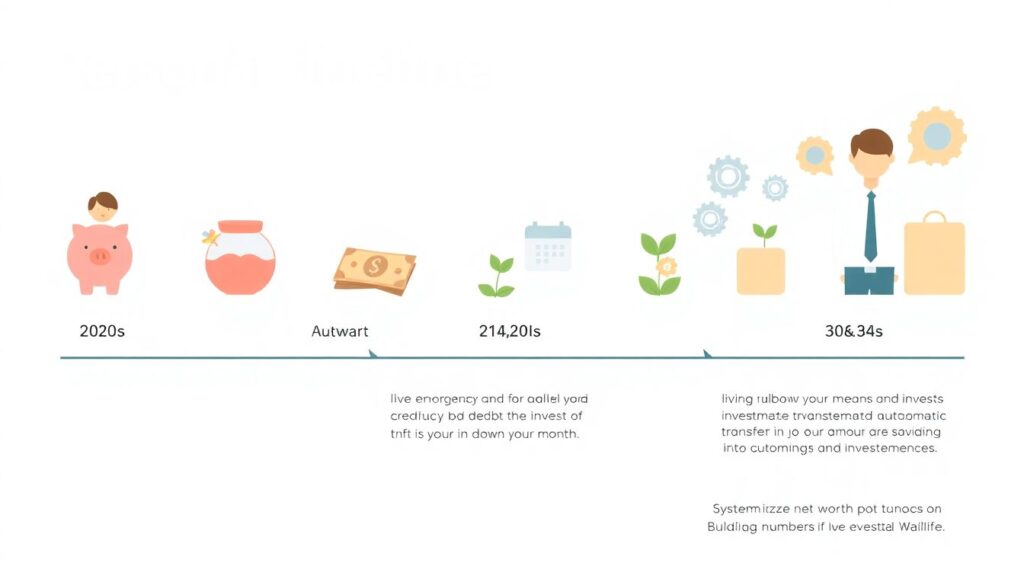
Instead of obsessing over exact net worth benchmarks by age, think in terms of direction and momentum:
1. 20s: Prove you can live below your means, build an emergency fund, pay down bad debt, and start investing something—no matter how small—every month.
2. 30s: Systematize: automate savings and investing, get serious about career strategy, and make housing decisions aligned with your cash flow, not social pressure.
3. 40s: Optimize: close any retirement gap with higher savings rates, refine your portfolio, and protect your life with insurance and multiple income options.
4. 50s and beyond: Convert from “more, more, more” to “enough, and sustainable.” Clarify what lifestyle you want, model different retirement ages, and make decisions—downsizing, relocating, semi‑retiring—that support it.
These aren’t rigid stages; life is messier than that. But they reflect how risk, time, and opportunity typically evolve, and they line up with the best investment strategies for 20s 30s 40s and later: more growth and experimentation early, more balance and protection later.
—
Putting it all together in 2025

In a world of AI‑shaped careers, expensive cities, and longer lifespans, money milestones aren’t about perfection or status. They’re about bargaining with reality: using data, trends and a bit of foresight to give your future self more choices than your past self had.
The practical move today is simple: figure out where you are (income, debt, savings, investments), map it to your decade, and pick one or two next steps that actually fit your life. Then let time, automation, and compounding do what they’ve always done—quietly turn small, consistent moves into something big enough to matter.