
Why an Investment Policy Statement Matters Today
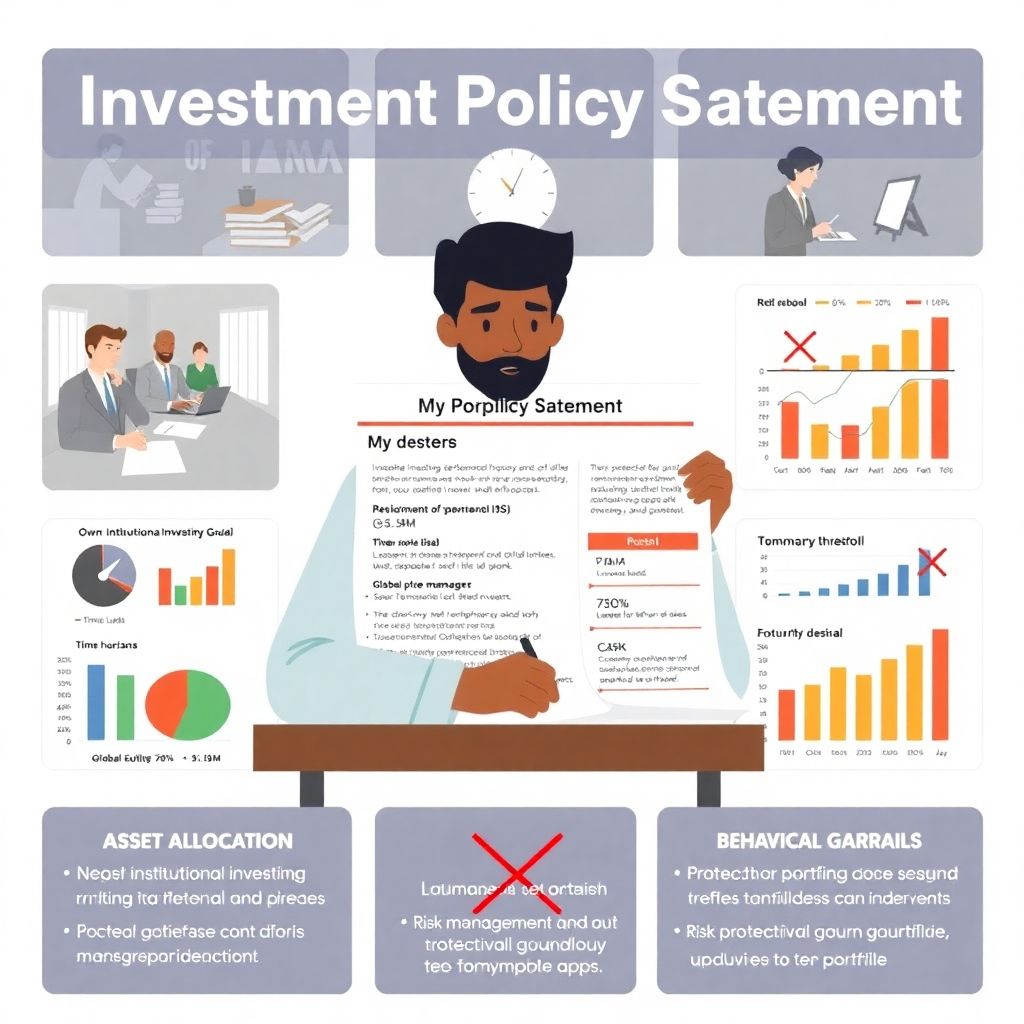
An Investment Policy Statement (IPS) sounds like something only a pension fund would use, but for personal finance it’s basically your written “money constitution”. Over the last three years the need for structure has only grown. According to the 2022 Federal Reserve Survey of Consumer Finances, about 58% of U.S. households owned stocks directly or through funds; by 2024, Vanguard reported that more than 40% of new retail accounts were trading at least monthly. At the same time, 2023 DALBAR research again showed that the average equity investor underperforms the market mainly because of emotional timing mistakes. A clear IPS doesn’t promise higher returns on its own, but it sharply reduces the odds that you’ll blow up a decent plan during the next bout of market drama.
Historical Background of the IPS Concept
The idea of an IPS comes from institutional money management in the 1970s–1980s, when pension funds and endowments needed a formal way to align investments with long‑term obligations. As modern portfolio theory spread and fiduciary rules tightened, regulators and consultants pushed written policies as evidence of prudent decision‑making. Over time, wealth managers realized that households struggle with exactly the same issues: unclear goals, shifting risk appetite, performance chasing. Since about the mid‑2000s, large brokerages have quietly rolled out IPS tools for affluent clients, and in the last three years many retail platforms have started offering a basic investment policy statement template for individual investors, adapting institutional discipline to everyday portfolios.
Core Principles of a Personal IPS
Defining Goals, Time Horizon and Risk
A solid IPS starts by translating vague wishes into concrete targets. Instead of “retire comfortably”, you write something like: “I want $1.2M in today’s dollars by age 65, saving $1,000 a month and investing 80% in growth assets.” Over 2022–2024, most planning studies (Fidelity, Schwab, Vanguard) kept confirming the same pattern: people who specify measurable goals and timelines are more likely to stay invested through volatility. Your IPS should list each major goal, its time horizon, required return and acceptable risk band. Here you also define your “panic threshold”: for example, acknowledging in writing that you can tolerate a 20–25% temporary decline without radically changing strategy.
Asset Allocation and Rebalancing Rules
Once goals and risk tolerance are on paper, the IPS spells out your target asset allocation: the percentage in stocks, bonds, cash and any alternatives. Numerous studies between 2022 and 2024 reiterated that asset allocation explains the bulk of long‑term return variability, far more than security selection. Your IPS should specify target ranges, such as “Global equities 70% ± 5%, investment‑grade bonds 25% ± 5%, cash 5% ± 3%.” Just as important are the rebalancing rules: how often (calendar‑based, say once or twice a year) or threshold‑based (when any asset drifts more than 5 percentage points from target). Writing this down in advance helps you buy low and sell high mechanically, instead of relying on gut feelings in stressed markets.
Risk Management and Behavioral Guardrails
Risk management in an IPS isn’t only about volatility; it’s also about behavior under stress. From 2022 through 2024, global markets saw spikes around inflation worries, rate hikes and geopolitical shocks, and each time trading apps reported surges in panic selling. To counter this, specify in your IPS what you will *not* do: for instance, “I will not move more than 20% of my portfolio to cash based on headlines alone” or “Individual stock positions will not exceed 5% of total assets.” Include guidelines on leverage, options, crypto and concentrated positions in employer stock. These guardrails don’t remove risk; they keep foreseeable, repeatable mistakes from wrecking the rest of your careful planning.
Step‑by‑Step: How to Create Your Own IPS
Practical Sequence for Building an IPS
1. Clarify your financial situation and goals.
Start with a quick balance sheet: assets, debts, income, essential expenses and current savings rate. Then list your top three to five goals—retirement, home purchase, kids’ education, early semi‑retirement and so on. Over the last three years, planning software used by advisors has improved a lot, but you can do a rough version in a spreadsheet. For each goal, note the target amount in today’s money, the deadline and how flexible the timing is. The point is not to predict your life perfectly, but to replace fuzzy intentions with numbers that can anchor the rest of your IPS assumptions.
2. Choose your risk level with data, not vibes.
Risk tolerance questionnaires aren’t perfect, yet studies from 2022–2024 show they’re better than pure intuition. Look at historical drawdowns for different stock/bond mixes—many broker sites provide charts. Ask yourself whether you could sleep at night during a 30% drop, which has occurred multiple times in modern market history. Put in writing both your preferred allocation and an absolute maximum loss you can accept without abandoning the plan. If you’re unsure, this is where a financial advisor for creating investment policy statement can add value, because they’ve seen how different personalities react when markets slide sharply.
3. Define asset allocation, instruments and contribution rules.
Now convert your risk choice into a portfolio recipe. Specify ranges for domestic vs. international stocks, government vs. corporate bonds, and whether you’ll use index funds, ETFs or some active funds. Between 2022 and 2024 the shift into low‑cost index ETFs continued, with U.S. ETF assets crossing $8 trillion, underlining how core indexing has become for long‑term investors. Your IPS should also say how much you’ll invest monthly or annually, which accounts you’ll prioritize (401(k), IRA, taxable) and how you’ll increase contributions when income rises, for example by automatically devoting half of every raise to savings.
4. Write rebalancing, withdrawal and review policies.
Specify when you’ll rebalance and how you’ll draw down money in retirement or for big goals. Research over the past three years suggests that annual or semi‑annual rebalancing captures most of the benefit without excessive trading. For withdrawals, you might include a range like “Base withdrawal rate 3.5–4% of portfolio per year, adjusted for inflation, with cuts if portfolio falls more than 15%.” Add a review schedule—say once a year or after major life events—to update assumptions. This section turns your IPS into a living document instead of a forgotten PDF buried in your email archive.
Examples of IPS Implementation in Real Life
DIY Investor with Template‑Based IPS
Imagine a 35‑year‑old professional with a mix of retirement and brokerage accounts. She downloads an investment policy statement template for individual investors from a brokerage website and customizes it: 80% global stocks, 20% high‑quality bonds, contributions of $1,500 monthly, and strict limits on speculative positions to 5% of the portfolio. During the market volatility of 2022 and the regional banking scare of 2023, her portfolio temporarily dropped over 20%. Instead of bailing out, she re‑read the IPS, saw that such drawdowns were anticipated and even rebalanced by buying more equities. By late 2024, her returns roughly matched a standard global 80/20 benchmark, while several friends who panic‑sold lagged by several percentage points annually.
Investor Using Advisors and Automation
Now picture a couple in their late 40s with higher income but limited time. They decide to hire personal financial planner for long term investment strategy, focusing on retirement at 62 and college for two kids. The planner leads a structured IPS process, then implements it partly through a managed account and partly through the best robo advisor for personalized investment plan to keep fees under control. From 2022 to 2024 they experience inflation spikes, rising rates and uneven stock performance, but the IPS keeps their strategy consistent: they gradually shift from 80/20 to 65/35, rebalance annually, and increase 529 contributions when bonuses arrive. The mix of human guidance and automation turns the IPS from a theoretical paper into practical, day‑to‑day discipline.
Common Misconceptions About Investment Policy Statements
“An IPS Is Only for the Rich or for Institutions”
A persistent myth is that only large funds or ultra‑wealthy families need an IPS. In reality, the behavioral challenges are almost identical for someone managing $50,000 in ETFs and a foundation managing $50 million. Surveys between 2022 and 2024 repeatedly showed that even modest‑balance investors with written plans were likelier to stay invested and meet savings targets than higher‑income households without a plan. You don’t need complex language or legal boilerplate; a two‑page document in plain English that you actually understand is far more useful. It’s not the size of the portfolio that demands an IPS, but the human tendency to overreact when the news flow turns ugly.
“If I Have an Advisor, I Don’t Need an IPS”
Another misconception is that delegating to a professional makes an IPS redundant. In practice, a good advisor will insist on one. A fee only financial advisor for retirement and investment planning uses the IPS as a shared reference point: it clarifies the mandate, documents risk tolerance and protects both sides from misunderstandings when markets get rough. If your advisor manages your portfolio without any written policy, that’s a red flag. Even robo‑based solutions benefit; many platforms now embed IPS‑like questionnaires and summaries in their onboarding flow, because regulators and clients alike expect a transparent explanation of why a given portfolio is suitable for a particular person and goal.
“An IPS Locks Me In and Kills Flexibility”

Some investors worry that committing to an IPS will leave them unable to adjust when life changes. The opposite is true if the document is written sensibly. The IPS is meant to be stable with respect to *process* but adaptable regarding inputs. When you change jobs, move countries, have children or inherit money, you update the assumptions—income, goals, time horizons—then revisit allocation and contributions. The last three years offered plenty of examples: people who lost or switched jobs in 2022–2023 and had an IPS generally adjusted calmly, while those without one tended to react haphazardly. The policy doesn’t forbid change; it simply forces you to change for reasons grounded in your life rather than in market noise.