

Why “Debt‑Free Living” Became a Big Deal for Recent Grads
If you’re finishing college around 2025, you’re stepping into a world that’s been arguing about student debt for almost two decades straight. The 2008 financial crisis pushed a whole generation into the job market with weak salaries and record education costs. By the late 2010s, headlines about the “student debt crisis” were constant, and policymakers started rolling out new student loan repayment programs for recent graduates in an attempt to stop the bleeding.
Then came 2020. The pandemic paused federal student loan payments for years, which gave a lot of young adults their first taste of what life without loan payments could feel like. At the same time, fintech exploded: budgeting apps, robo‑advisors, and micro‑investing tools made it easier than ever to track every dollar and automate financial behavior. By 2025, “debt‑free living” is not some fringe idea; it’s a mainstream financial strategy, especially for new grads who watched older millennials struggle.
So when we talk about debt‑free living today, we’re not talking about living off the grid or shaming anyone who has loans. We’re talking about building a system where you use credit intentionally, avoid high‑interest traps, and structure your early career so that debt never becomes the thing that controls your choices.
—
Core Principles of Debt‑Free Living for Recent Graduates
1. Positive Cash Flow as the Non‑Negotiable
Debt‑free living starts with a simple but strict rule: your net cash flow must be positive most months. In technical terms, your recurring inflows (after‑tax income) must exceed your recurring outflows (fixed and variable expenses) with some margin. That surplus is your “financial engine” — it powers saving, investing, and accelerated debt payoff.
Without this surplus, everything else is just theory. You can use the best budgeting apps for college graduates, build detailed spreadsheets, or download every template on the internet; if the math says you’re negative, you are financing your lifestyle with debt.
Short version: more in than out, consistently.
—
2. Aligning Debt With Assets, Not Consumption
In finance, “good” debt is usually tied to assets that keep or grow value (like certain degrees or a reasonably priced home), while “bad” debt is tied to fast‑depreciating consumption (vacations on a credit card, impulse electronics, lifestyle creep).
For a recent graduate, the line is simpler:
– Debt that increases long‑term earning power or essential stability can be acceptable.
– Debt that only upgrades your lifestyle without increasing your resilience is a liability in every sense.
This doesn’t mean you must be perfect; it means you adopt a default stance: avoid borrowing for lifestyle, be cautious even when borrowing for “opportunity.”
—
3. Automate Everything You Can
Automation reduces “behavioral risk” — the risk that you’ll simply forget, procrastinate, or give in to impulses.
Minimal but powerful automations for a new grad:
1. Automatic transfers to savings right after payday.
2. Automatic minimum payments on every loan and credit card.
3. Automatic contributions to retirement accounts if your employer offers them.
You can then add manual “top‑up” payments when you have surplus cash, but the backbone runs without you remembering anything. This is especially important when you’re figuring out how to pay off student loans fast after graduation, because consistency is more powerful than occasional heroic payments.
—
4. Building a Small but Real Safety Buffer
Debt‑free living is not just “no balances.” It’s also about not being forced back into debt whenever something breaks.
Technically, you’re aiming for a liquid emergency fund: cash (or cash‑equivalents) you can access quickly without penalties. For a recent grad, a realistic first benchmark might be:
– 1 month of essential expenses → then
– 3 months of essential expenses over time
This buffer is what keeps one flat tire or one medical copay from turning into a credit‑card spiral.
—
5. Protecting Your Credit, Even if You Hate Debt
It sounds paradoxical, but a debt‑free strategy still needs a healthy credit profile. Your credit score affects:
– Renting an apartment
– Insurance premiums (in some regions)
– Future borrowing costs, if you ever do take on a mortgage or auto loan
The technical levers are straightforward: low utilization (keep used credit well below limits), on‑time payments, limited hard inquiries, and long average account age. You don’t have to love credit cards to use them strategically.
—
Historical Context: How We Got to 2025’s Debt‑Free Playbook
From around 2000 to the mid‑2010s, the assumption in many households was: “Go to the best school you can get into; we’ll figure out the loans.” Tuition rose faster than wages, and easy credit filled the gap. Financial literacy education lagged far behind the complexity of repayment options and loan structures.
After 2008, the mismatch between debt and income became painfully obvious. Many graduates were “underemployed,” working outside their field or for lower pay than expected, while carrying five figures of debt. Conversations about income‑driven repayment, refinancing, and forgiveness moved from financial‑planner offices to mainstream social media.
The 2020–2023 payment pause on federal loans was an accidental live experiment. Millions of people experienced a temporary version of debt‑free living, even if their balances still existed on paper. Some households used the freed‑up cash for emergency funds and investing; others absorbed it into lifestyle upgrades. Policymakers extended and modified student loan repayment programs for recent graduates during this period, tweaking interest subsidies and forgiveness conditions.
By 2025, three things are different from, say, 2010:
– There is much less blind faith that “any degree at any price” is worth it.
– There is much more access to low‑cost digital tools for tracking and planning.
– There is much more skepticism about high‑interest consumer debt.
Debt‑free living for new grads is built on that history: it’s a corrective response to two decades of over‑leveraging in education and lifestyle.
—
Practical Implementation: Turning Principles Into Daily Habits
Step 1: Establish a Baseline Financial Snapshot
Before you optimize anything, you need a snapshot:
1. List all income sources after tax.
2. List all recurring bills (rent, utilities, subscriptions, insurance).
3. List variable spending (food, transport, entertainment).
4. List every debt: balances, interest rates, required minimums.
This isn’t about judging yourself; it’s about building a simple personal balance sheet and cash‑flow statement. Once you see your true monthly surplus (or deficit), you can design an actual plan instead of guessing.
—
Step 2: Build a Lightweight Budget You’ll Actually Use
Forget 40‑category spreadsheets if you’re not a spreadsheet person. You need a system that’s low friction but accurate enough.
A common pattern that works for recent grads:
– Fixed costs: rent, utilities, minimum loan payments, insurance
– Essentials: groceries, transport, phone
– Discretionary: everything else
Many of the best budgeting apps for college graduates now use automatic categorization and “envelope” style planning: you tell the app how much per month you want in each category, and it tracks whether you’re on pace. The tech isn’t magic, but it eliminates manual data entry and surfaces problems fast.
—
Step 3: Choose a Debt Strategy and Stick to It
If you have multiple debts, you want a structured method, not random extra payments.
Two common frameworks:
1. Debt Avalanche (mathematically optimal)
– Target the highest interest rate first while paying minimums on others.
– Reduces total interest paid, ideal if you’re disciplined.
2. Debt Snowball (behaviorally powerful)
– Target the smallest balance first to get faster “wins.”
– Encouraging if you’re easily discouraged by big numbers.
For many recent grads, combining these with automation — like scheduling a fixed “extra payment” on the current target debt right after payday — is what makes progress visible.
—
Step 4: Evaluate Consolidation and Refinancing Options
With higher rates in parts of the 2020s, debt consolidation options for recent graduates are less of an obvious win than they were when rates were near zero, but they’re still worth a careful check.
In practice, you’re asking:
– Can I lower my effective interest rate?
– Can I simplify the number of payments?
– Am I giving up useful benefits (for example, income‑driven repayment, forgiveness, or deferment options on federal loans)?
For federal student loans, a Direct Consolidation Loan can simplify repayment but doesn’t always reduce cost. For private loans or high‑APR credit cards, refinancing to a lower rate can significantly accelerate your path to debt‑free living — as long as you don’t treat the freed‑up cash as “new spending money.”
—
Step 5: Use Programs and Services Meant Specifically for New Grads
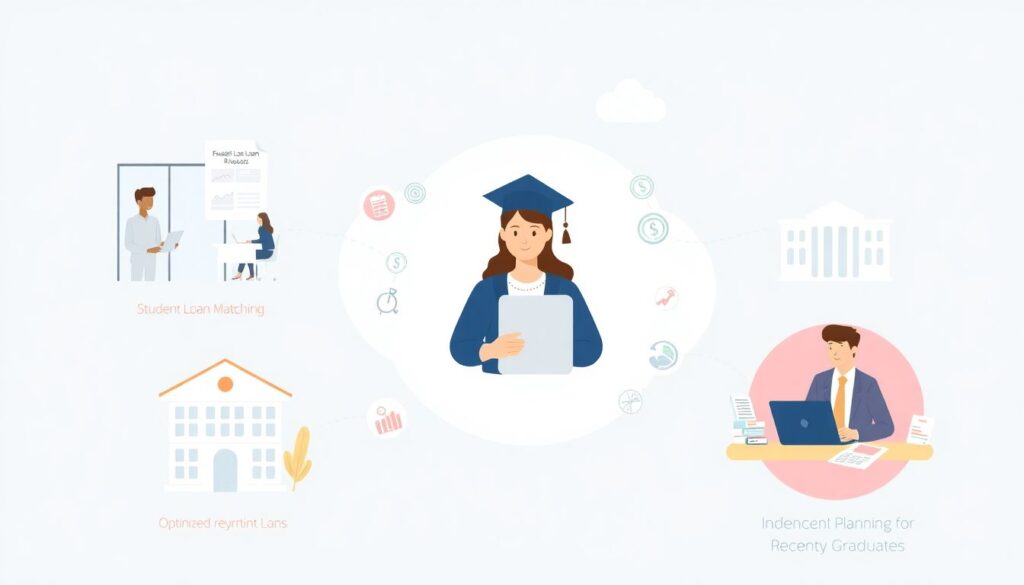
Over the last decade, a small ecosystem of offerings has emerged around you:
– Employers increasingly provide student loan matching or contributions.
– Universities partner with platforms that help optimize repayment plans.
– Independent planners offer financial planning services for recent college graduates with flat‑fee or subscription models instead of traditional high minimums.
On top of that, various student loan repayment programs for recent graduates (especially public‑service‑oriented ones) can reduce total repayment costs dramatically if you meet their criteria. The key is to actually read the eligibility rules and not assume you’re excluded.
—
Real‑World Scenarios: How Recent Grads Put This Into Practice
Case 1: The “I Want Out of Debt in Five Years” Engineer
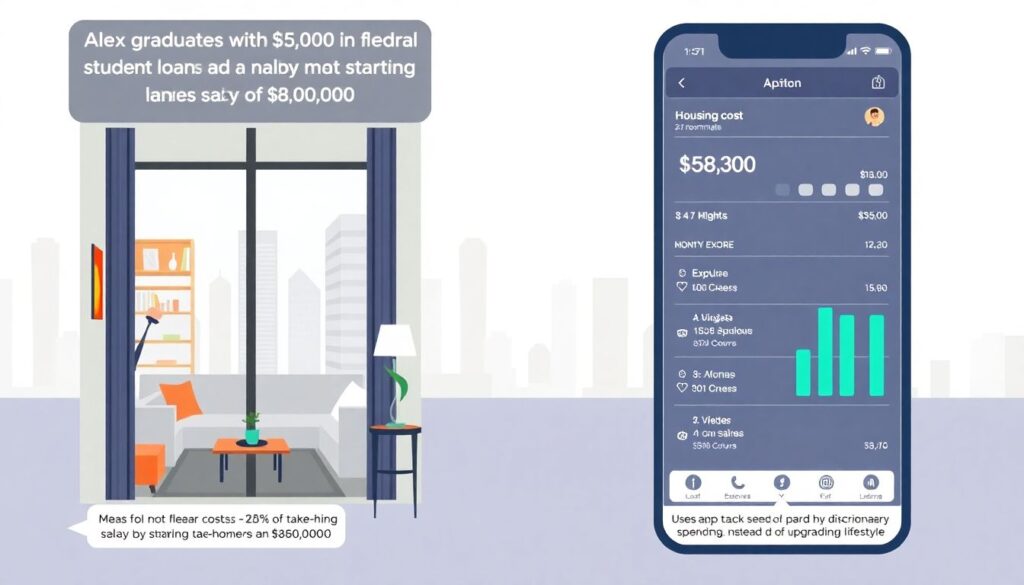
Alex graduates with $35,000 in federal student loans and a starting salary of $80,000 in a major metro area. Instead of upgrading lifestyle immediately, Alex:
– Keeps housing costs at ~25% of take‑home pay by sharing a modest apartment.
– Uses an app to track spending and caps discretionary spending at a fixed weekly amount.
– Chooses the standard 10‑year repayment plan, but pays 50% above the required minimum every month via automation.
By directing every raise and bonus toward the loans for the first few years, Alex effectively compresses a 10‑year schedule into roughly 5–6 years, without living in extreme deprivation. Once the debt is gone, those same dollars get re‑routed into investments, and lifestyle upgrades happen gradually, not all at once.
—
Case 2: The Public‑Service Professional Using Forgiveness Rules
Jordan completes a social work degree with $60,000 in federal loans and a salary under $50,000 at a qualifying nonprofit. Rather than obsess over “fast payoff,” Jordan:
– Enrolls in an income‑driven repayment plan that sets payments as a percentage of discretionary income.
– Keeps an emergency fund of two months’ expenses to avoid credit‑card dependence.
– Carefully documents employment for Public Service Loan Forgiveness requirements.
Jordan’s path is not about eliminating the balance immediately but about minimizing risk and maximizing the benefit of programs designed for lower‑income public‑service careers. Debt‑free living here means “not drowning in payments” and eventually achieving cancellation, rather than zeroing the balance in a few years.
—
Case 3: The Creative Freelancer Smoothing Irregular Income
Taylor graduates from a design program, goes freelance, and faces highly volatile income. Debt‑free living here focuses on cash‑flow smoothing:
– Taylor builds a “buffer account” equal to three months of average expenses.
– Every client payment goes into the buffer first, then Taylor pays a fixed “salary” from that buffer each month.
– Loan payments and core bills are scheduled right after the self‑paid salary hits.
By turning irregular income into regular cash flow, Taylor can commit to a stable repayment schedule and avoid going into debt during slow months.
—
Common Myths and Misconceptions About Debt‑Free Living
Myth 1: “Debt‑Free Living Means Never Borrowing for Anything”
In reality, debt‑free living is about being free from *uncontrolled* or *unnecessary* debt, not about refusing every form of credit forever. Using a zero‑interest payment plan for a necessary laptop or taking on a well‑priced mortgage later in life can fit into a debt‑conscious strategy, as long as the payments are easy to sustain and the asset is worth the obligation.
What you’re rejecting is high‑interest, revolving debt for recurring lifestyle upgrades, not every structured loan under any circumstances.
—
Myth 2: “There’s No Point Trying Until I Make a Lot More Money”
Income matters, obviously. But the habits that keep you out of trouble — tracking, automating, avoiding impulse borrowing — do not magically appear at $100,000 per year. People with high incomes and no control over spending can be as stressed as low‑earners with tight but disciplined budgets.
Building the mechanics of a surplus, even if it’s small, is what creates options. When your income grows, those same mechanics scale.
—
Myth 3: “Debt Consolidation Is Always the Smart Move”
Consolidation is a tool, not a default solution. Sometimes it lowers your rate and simplifies life. Other times it:
– Extends the term so much that you pay more total interest.
– Strips away protections you had on federal loans.
– Encourages complacency: the single, lower payment feels easier, so you stop making extra payments and drag out the process.
The test is straightforward: compare total projected interest and flexibility before and after consolidation, not just the monthly payment.
—
Myth 4: “Budgeting Means Never Having Fun”
A budget is not a punishment list; it’s an allocation plan. If you explicitly set aside money for travel, dining out, or hobbies, then spending that money is not “breaking the rules” — it is following your own rules.
What actually kills progress isn’t planned fun; it’s unplanned leakage: the extra subscription you forgot to cancel, the recurring delivery orders you never decided on consciously, the non‑stop micro‑purchases that don’t bring much joy individually but collectively block your goals.
—
Myth 5: “Professional Advice Is Only for Rich People”
Historically, traditional financial advisors targeted high‑net‑worth clients. In 2025, that’s changed. Many platforms and independent planners explicitly design packages for new grads, including one‑time “financial checkups” and low‑fee ongoing support. Financial planning services for recent college graduates are often priced more like a gym membership or streaming bundle than an elite luxury.
If your situation is complex — mixed loans, family obligations, variable income — paying for a session or two to design a roadmap can pay for itself in avoided mistakes.
—
Putting It All Together in 2025
Debt‑free living for recent graduates is not a moral scorecard; it’s a risk‑management framework. You use simple, repeatable mechanisms — positive cash flow, automation, cautious borrowing, emergency buffers — to keep debt from dictating your career and life choices.
In a world where education is expensive, housing is tight in many cities, and economic conditions shift quickly, the goal isn’t perfection or never touching credit. The goal is resilience: the ability to move apartments, change jobs, go back for additional training, or launch a project without being trapped by legacy obligations.
If you can look at your loans, your spending, and your savings and say, “I understand this, it’s intentional, and it’s moving in the right direction,” you’re already practicing debt‑free living — even if the balances haven’t hit zero yet.