
Why Your Portfolio’s Fees Matter More Than You Think
Most investors obsess over returns and completely ignore what quietly eats those returns year after year: fees and expenses. A portfolio that “only” loses 1–1.5% annually to costs can trail a leaner portfolio by tens of thousands over a couple of decades.
Let’s unpack what you’re actually paying, how to read between the lines of fancy brochures, and what you can *realistically* do in 2025 to take back control—without turning into a full‑time trader.
—
The Real Fee Stack: What You’re Actually Paying
The Big Buckets of Costs
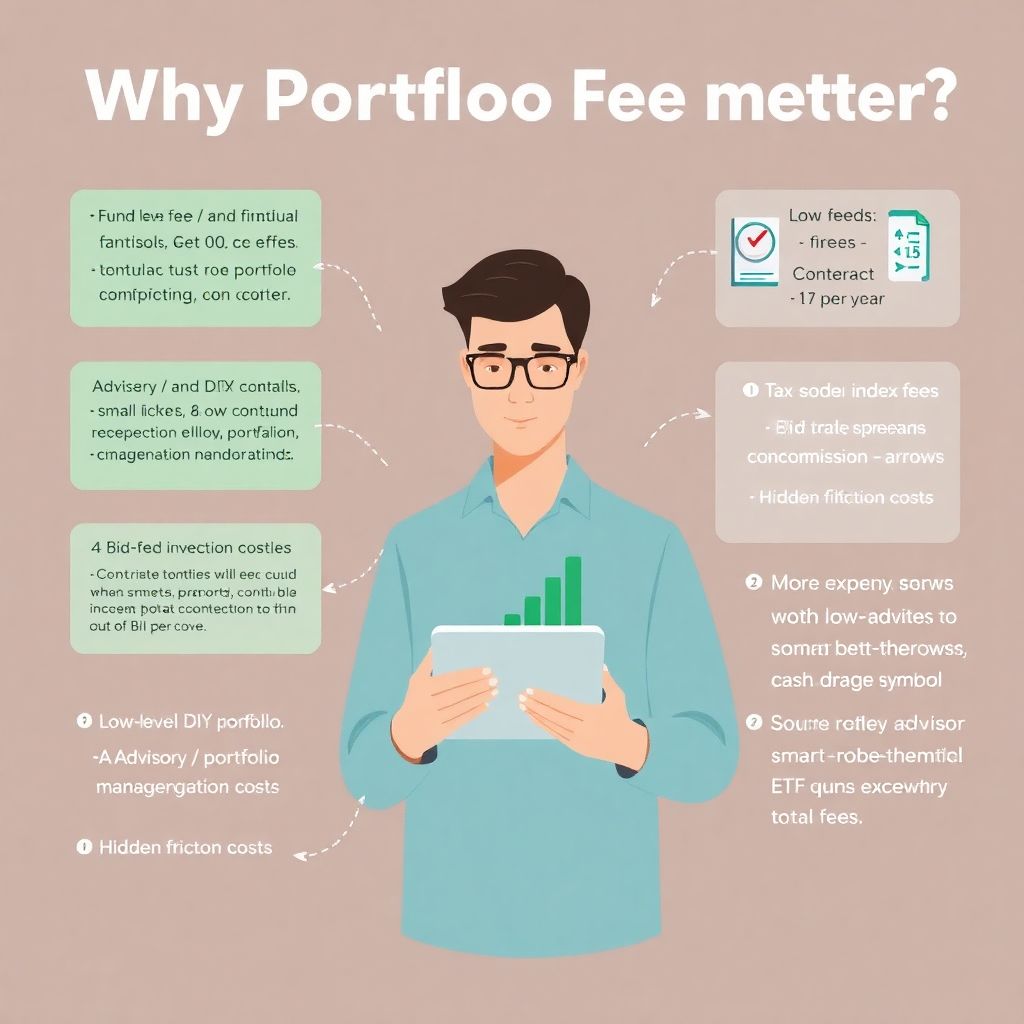
Long story short, most portfolios pay at least four layers of cost:
– Fund-level fees: expense ratios of mutual funds and ETFs
– Advisory / portfolio management: what you pay a person or firm to manage your money
– Transaction-related costs: spreads, commissions (less common now), and implicit trading costs
– Hidden “friction” costs: taxes, cash drag, currency conversion, and slippage
Even if your advisor says “We only charge 1% per year,” your *all‑in* cost might be closer to 1.5–2% once you add fund expenses, trading and tax friction.
A practical habit: once a year, do your own mini investment management fees comparison. Put total dollars paid in fees next to your portfolio value. If that number is over 1.25–1.5% all‑in, your portfolio is probably working harder for your providers than for you.
—
Comparing Different Approaches to Managing Your Portfolio
1. DIY Investor With Passive Funds
You pick your own funds, rebalance occasionally, and avoid paying for advice.
What this usually looks like:
– Portfolio built mostly with low cost index funds with minimal fees
– You handle rebalancing 1–2 times per year
– You keep cash for emergencies outside the portfolio
Pros:
– Rock-bottom fees if you’re disciplined
– Full control and transparency
– Perfectly suited to simple “set it and forget it” strategies
Cons:
– Easy to panic‑sell in volatility
– No one to challenge your biases or overconfidence
– Tax optimization and estate planning often get ignored
DIY is ideal for people who are willing to learn a bit, can handle market swings emotionally, and don’t have very complex financial situations.
—
2. Robo-Advisors and Automated Portfolios
Robo-advisors exploded because they’re cheaper and more convenient than most traditional advisors. They generally use ETFs, algorithmic allocation and auto‑rebalancing.
Upsides:
– Low headline advisory fee (often 0.2–0.4%)
– Automatic rebalancing and sometimes tax‑loss harvesting
– Easy to start with small amounts
Downsides:
– Advice is standardized; nuance is limited
– Some platforms add expensive proprietary funds inside the portfolio
– Algorithms can’t fully account for your personal quirks (and you *definitely* have them)
This is a good halfway house: lower fees than old‑school advisors, but with more support than pure DIY.
—
3. Full-Service Human Advisors
You get a person, maybe a team, who looks at your investments, taxes, insurance, and goals. This is where the portfolio management services fee structure really matters.
Common models:
– AUM (assets under management): 0.5–1.5% of your portfolio annually
– Flat fee: a fixed amount per year, regardless of portfolio size
– Hourly: you pay like you would pay a lawyer or consultant
High-quality, best financial advisors with transparent fees will show you in writing:
– Exactly what services you’re getting
– What you pay, and how it could change as your portfolio grows
– Any commissions or soft-dollar arrangements, if they exist
Human advice shines in complexity—think business owners, major stock compensation, large estates—but you must relentlessly question the value you get for the ongoing cost.
—
Technology in Investing: Pros, Cons, and Where It Actually Helps
The Good Side of Tech
Modern platforms have made fee control dramatically easier:
– Instant investment management fees comparison across funds and ETFs
– Apps that show you total fees paid this year in real dollars
– Automatic alerts when a cheaper share class or ETF equivalent exists
Key advantages of current tech:
– Better transparency at the fund level (expense ratios, turnover, tracking error)
– Automated tax‑loss harvesting in certain robo platforms
– Fractional shares and commission‑free trading, reducing explicit transaction costs
—
Where Technology Can Backfire
Not all “innovation” is investor‑friendly.
Short points, but critical:
– “Free trading” can encourage overtrading, which *increases* hidden costs
– Complex leveraged or inverse ETFs can have brutal implicit expenses
– Smart‑beta and “thematic” funds often sneak in higher expense ratios
– Advisor dashboards might simplify costs for the advisor, not for you
When you see tech‑heavy marketing, ask: Does this reduce my cost, my risk, or my stress? Or is it just shiny?
—
How to Reduce Mutual Fund and ETF Expenses Without Wrecking Your Strategy
A Simple, Non-Obvious Playbook
You don’t need heroic measures. You need consistency and a few slightly unconventional moves.
1. Upgrade share classes
Many investors hold retail share classes that are pricier than institutional or “clean” share classes. Ask your provider if cheaper classes of the same strategy are available. Same portfolio, lower cost.
2. Consolidate overlapping funds
If you own three U.S. large‑cap funds that look 90% identical, collapse them into *one* of the cheaper options. That move alone can drop costs by 0.1–0.3% a year.
3. Use ETFs strategically, not ideologically
Mutual funds are not “bad,” and ETFs are not automatically “good.” The question is: *What’s the cheapest, most tax‑efficient way to own this exposure in my account type?*
4. Create a “fee diet” rule
Decide on a personal ceiling: for broad market exposure, you simply won’t buy anything with an expense ratio above, say, 0.20%. For niche strategies, maybe 0.50%. Stick to your rule unless the value is extraordinary and you can defend it logically.
5. Turn tax into a fee-reduction weapon
Realize capital losses intentionally (in taxable accounts) and pair them with gains. Over a decade, thoughtful tax‑loss harvesting can offset some or all advisory and fund expenses.
—
Nonstandard Strategies for Beating Fee Creep

Let’s go beyond the usual “buy cheaper funds” advice.
1. Outsource Asset Allocation, Insource Implementation

Pay an advisor or planner a flat fee just to design your strategic allocation and tax plan. Then implement the plan yourself using cheap vehicles.
For example:
– Once a year, you pay for a 2–3 hour review: goals, risk, tax questions
– They give you a precise asset mix and a list of recommended funds (tickers included)
– You use a discount broker and low cost index funds with minimal fees to build and maintain it
You get expertise when it matters most (design, tax, major life changes), but avoid permanent percentage-of-assets fees.
—
2. Create a “Core & Sandbox” Structure
If you’re drawn to “interesting” investments—AI themes, crypto, private deals—create a strict separation:
– Core (80–95%)
– Ultra‑low‑cost index funds and plain-vanilla ETFs
– Minimal turnover, tight fee control
– Sandbox (5–20%)
– Actively managed funds, speculative bets, or niche ETFs
– You consciously accept higher fees and risk here
This keeps the bulk of your wealth fee-efficient and diversified, while still scratching the itch to experiment. It also makes it easy to see if your “clever” ideas are really worth the added costs.
—
3. Invert the Relationship With Your Advisor
Instead of “I’m giving you 1% every year because that’s how it’s done,” ask:
> “Here’s what I need: planning, tax guidance, and a second opinion on big decisions. What’s the least expensive, most aligned fee model that lets you do that profitably?”
You might end up with:
– A lower AUM fee that drops as your assets grow
– A retainer model with fixed annual pricing
– A hybrid: small AUM fee plus cap, so it doesn’t scale indefinitely
Shifting the conversation from “this is our standard fee” to “let’s design a structure that fits what I actually use” is a very underused negotiation tactic.
—
How to Evaluate Different Fee Structures in Practice
3 Critical Numbers to Calculate
When comparing advisory or Robo offers, don’t get lost in jargon. Focus on:
– All‑in percentage fee
Advisory + average fund fees + platform costs, divided by portfolio size
– All‑in dollar fee per year
If you’re paying $7,000 a year, it *should* feel like buying a used car annually—because that’s the scale
– Break-even benefit required
Ask yourself: “What concrete value am I getting that plausibly exceeds this yearly cost?”
Here’s a simple mental check:
– If your all‑in cost is 0.3–0.6%, you need modest but real value (automation, behavior coaching, basic tax efficiency).
– If it’s 1–1.5%, you should expect *significant* value: tax planning, complex advice, retirement modeling, integrated estate planning.
If you’re paying top‑tier fees for bottom‑tier services, something’s off.
—
2025 Trends in Investment Fees and What They Mean for You
Fee Compression Isn’t Over—But It’s Changing Shape
Several big shifts are underway in 2025:
– Plain-vanilla index funds are basically free
Providers compete on brand, platform, and service rather than price. Don’t overpay for a simple S&P 500 tracker when the market gives you absurdly cheap options.
– Advisors are moving to mixed models
More firms offer combinations of AUM, flat fee, and project-based work. This is great for informed clients who are willing to push for clarity.
– Regulation is tightening around disclosure
Many jurisdictions require cleaner breakdowns of client costs. Use this: ask advisors and platforms to present their fees in one clear page, in dollars *and* percentages.
– Smarter retail tools for fee analysis
Expect more apps that not only show fees but suggest realistic swaps and quantify impact over time. This takes investment management fees comparison to the next level—less about data, more about actionable suggestions.
—
Step-by-Step: Tune Up Your Portfolio’s Fees This Month
Here’s a straightforward action plan you can actually follow.
1. Get Your Numbers
– Pull your most recent statements (investment and advisory).
– For each account, write down: portfolio value, advisory fee, and rough average fund expense ratio.
– Add them to estimate your all‑in percentage.
2. Quick Wins on Costs
– Replace high-fee index or closet‑index funds with genuinely low cost index funds with minimal fees.
– Merge overlapping funds where possible.
– If a fund’s expense ratio is above your new “fee diet” threshold, challenge it: “Why this one specifically?”
3. Decide How You Want to Pay for Advice
Ask yourself:
– Do I really need full-service portfolio management, or mostly planning and guidance?
– Would a flat-fee or hourly relationship with one of the best financial advisors with transparent fees serve me better than a permanent AUM charge?
– Can I handle implementation if a professional sets the roadmap?
4. Review Once a Year
Mark a recurring calendar date: “Fee Review Day.”
On that day, review:
– All‑in cost this year vs. last year
– Any new services or value you received
– Opportunities to switch to cheaper share classes, funds, or fee models
If your cost goes up but the value doesn’t clearly improve, it’s time for a frank conversation—or a change.
—
Final Thought: Treat Fees Like a Risk You Can Control
You can’t control short‑term market returns. You *can* control how much you bleed in costs. That control is one of the few durable edges individual investors have.
Reducing fees isn’t about being stingy; it’s about making sure that the reward for taking risk flows to *you* first—not to layers of intermediaries.
Once you’ve cleaned up your portfolio management services fee structure, every future market upswing works harder for you. And that quiet compounding of saved costs, year after year, is one of the most powerful “non-obvious” investment insights you’ll ever put into practice.