
What “High-Impact Plans” Actually Mean
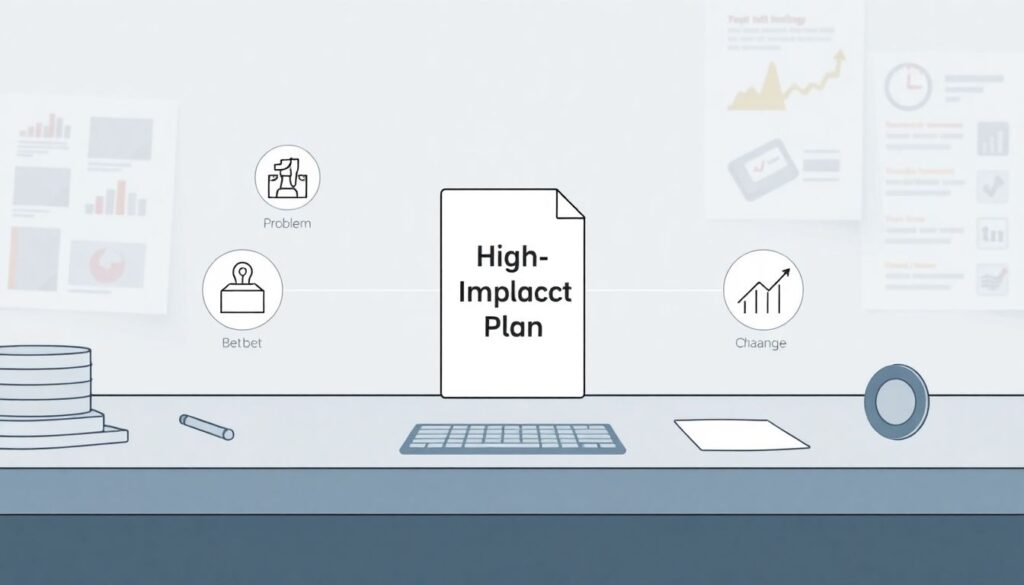
When people hear “high-impact plan”, they often imagine a glossy slide deck or an overcomplicated roadmap. In practice, a High-Impact Plan is a decision tool: a focused document that links three things — the problem, the bet you’re making, and the measurable change you expect. It cuts out noise and leaves only what shapes outcomes: assumptions, priorities, constraints, and metrics. Compared to traditional planning, which often captures “everything we could do”, a High-Impact Plan narrows down to “the few moves that really move the needle, and what we’ll sacrifice to make them happen”. That’s why high impact business plan services, when done well, feel less like paperwork and more like structured conversations about trade-offs and risk.
Short version: a High-Impact Plan explains why this path, why now, and how you’ll know it worked.
Key Terms Without the Buzzword Fog
Let’s keep the vocabulary lean so a cross‑functional team can actually use it. “Impact” is the delta between baseline and target: revenue, cost, churn, NPS, deployment speed — whatever truly matters. “Levers” are the minimal actions that can realistically move that metric: change pricing, launch a feature, shift budget, kill a project. “Bet” is a specific combination of levers plus a time window. “Evidence” is the mix of data, expert judgment, and constraints supporting that bet. If a plan doesn’t spell these out in plain language, it’s just a wish list in a nicer font.
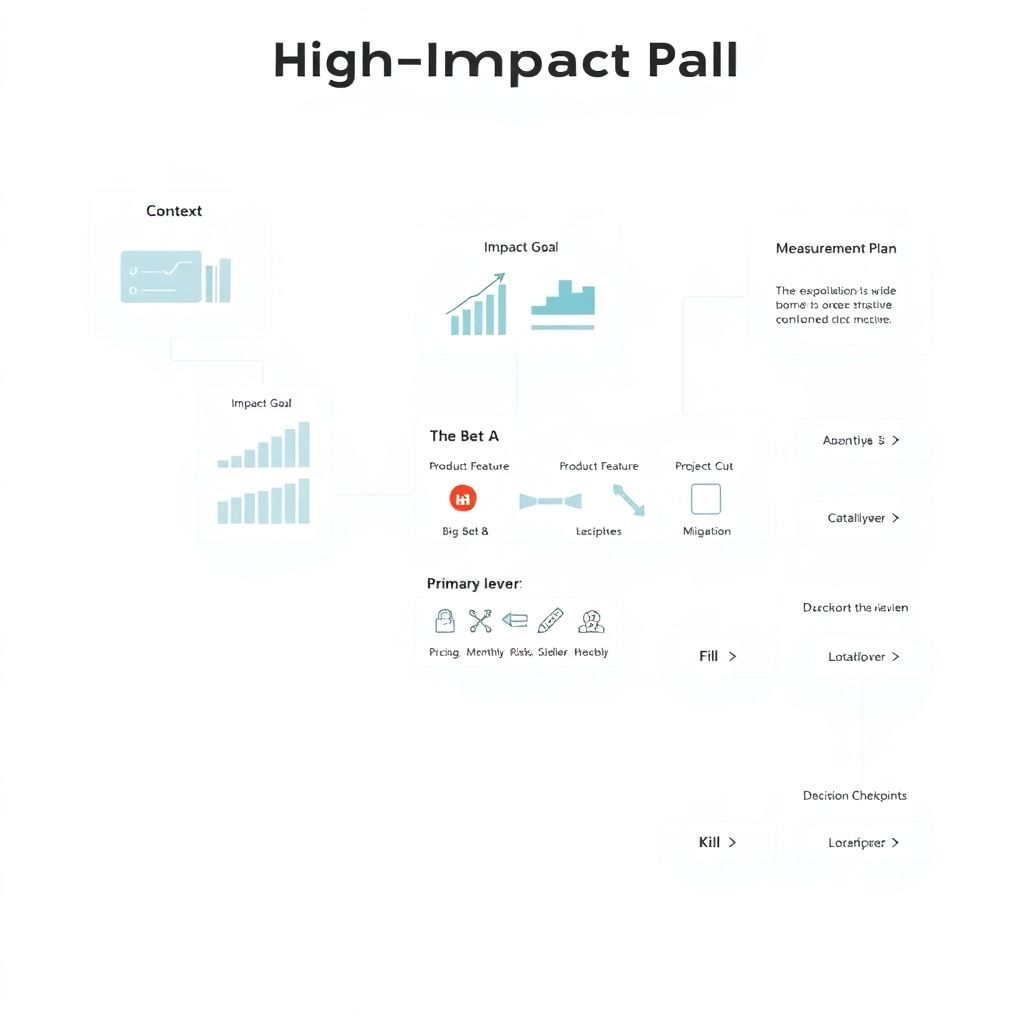
Text Diagram: How a High-Impact Plan Flows
Imagine a simple left‑to‑right flow instead of a maze of boxes. On the far left: [Context: current metric baseline + constraints]. Next block to the right: [Impact Goal: explicit target, time frame]. From that, three arrows fan out into [Bets A/B/C: each with a primary lever]. Under each bet hangs a smaller row of [Assumptions → Risks → Mitigations]. All of those arrows converge on a shared node: [Measurement Plan: what we track weekly, monthly, quarterly]. Finally, a last node: [Decision Checkpoints: kill / pivot / double‑down]. This diagram isn’t pretty for slides, but it makes sure no one forgets how the goal connects to daily actions.
Now compress that mentally into: Context → Goal → Bets → Assumptions → Metrics → Decisions.
How This Differs From Classic Strategic Planning
Traditional strategies often feel like novels: long, internally consistent, and rarely read twice. High-impact strategic planning consulting flips the emphasis from describing the world to choosing a small set of non‑obvious, testable moves. Instead of a 50‑page analysis and a vague “vision”, you get a 6‑ to 10‑page working document: three or four key bets, each with a clear mechanism, quantified upside, and explicit downside. The goal is not to forecast perfectly, but to shorten the feedback loop between “we think this will work” and “we now know if it works”. The result is a plan that can survive contact with reality because it expects to be wrong on details and bakes in a path to adapt quickly.
In short: less oracle, more lab notebook.
Case Study #1: SaaS Team That Stopped Building Random Features
A mid‑stage B2B SaaS company I worked with had a familiar problem: strong engineering, fuzzy direction. Their roadmap was essentially a backlog of “good ideas from important people”. Sales wanted customizations, marketing wanted new shiny features, the CEO wanted an AI module. Despite the noise, revenue was plateauing and churn was creeping up. We framed a High‑Impact Plan around one question: “What’s the minimum set of changes that could raise expansion revenue per account by 20% in 12 months?” That reframed every conversation. Most pet projects vanished when they couldn’t tie directly to that impact goal. Three bets survived: packaging changes, a guided onboarding revamp, and a simple usage‑based upsell trigger.
Twelve months later, expansion revenue went up by 24%, while engineering throughput barely changed. The gain came from focus, not heroics.
Definitions in Practice: Impact, Levers, and Bets in That Case
In that SaaS case, “impact” was measured as expansion MRR per customer. Levers were very concrete: (1) change plan boundaries to make upgrades inevitable for growing teams, (2) redesign the first‑week experience so more users hit their “aha” moment, (3) introduce contextual upgrade prompts tied to usage spikes instead of spammy email blasts. Each lever was packaged into a bet with a size and timeline: “Repackaging will likely add $60–90k MRR over 9 months if adopted by at least 30% of current accounts.” This translated abstract hopes into something the finance and product teams could both argue about — and then support — because the math, not the politics, sat in the middle.
That alignment is the real output of a High‑Impact Plan; the deck is just evidence it exists.
Marketing Angle: From Campaign Calendars to Impact Narratives
Marketing teams love motion — campaigns, channels, content. But constant activity can mask the absence of progress. That’s where high impact marketing plan templates can help, as long as they’re treated as skeletons for hard choices, not as decoration. An impact‑oriented marketing plan starts with a brutal constraint, like “Increase qualified pipeline by 40% without increasing total spend this quarter.” Then it forces side‑by‑side comparisons: Should you double down on one strong channel instead of five weak ones? Cut vanity content to fund conversion optimization? Turn off unmeasurable sponsorships in favor of experiments you can actually learn from? Good templates basically nag you into quantifying trade‑offs, so “brand awareness” becomes less mystical and more of a measurable bet tied to pipeline or retention.
The key is making every big marketing initiative earn its spot by showing its route to impact in advance.
Case Study #2: Startup Growth Plan That Didn’t Bankrupt the Team
A seed‑stage marketplace startup asked for help on a “go big or die” launch plan. Their first version had twelve parallel initiatives and a burn rate that would have killed them in eight months. We pivoted to a high impact growth strategy plan for startups approach: identify one main growth engine and two supporting bets, all sized against runway. The primary bet became “supply‑led growth” — deepen inventory in one vertical and one city, instead of thin coverage in many. Supporting bets: a referral program for top vendors and a focused outbound experiment to five large anchor clients. Each bet had a clear impact metric (filled requests per day, vendor retention, gross margin) and a kill switch if the early signal was weak.
They hit product‑market fit faster not because they were braver, but because they were more willing to abandon pretty ideas that didn’t actually move their three core metrics.
Where Tools and Software Actually Help (and Where They Don’t)
Software can’t decide your bets, but it can keep your plan from dissolving into status updates. Modern high impact project management plan software is most useful when it mirrors the logic of your High‑Impact Plan: goals at the top level, bets as epics, levers as tasks, and metrics wired into dashboards. Instead of dozens of disconnected boards, you get a single source of truth that says: “Here are the three bets we’re actively funding; everything else is background noise.” The real value shows up in review rituals: every two weeks, teams inspect metrics tied directly to those bets, not just task completion. If a bet isn’t moving its leading indicator, you don’t wait for the quarter to end; you cut or re‑shape it mid‑stream.
Tools are amplifiers. They make clarity powerful and confusion more expensive.
Consultants, Services, and When to Bring in Outside Help

Sometimes teams are too entangled in their own history to see clean options. That’s where high impact business plan services and high impact strategic planning consulting can genuinely help — not by providing a magical framework, but by facilitating the ugly conversations about what you’ll stop doing. A good external partner won’t write a 100‑page strategy tome; they’ll force explicit ranking of bets, run pre‑mortems on your favorite ideas, and make sure the CFO, CTO, CMO, and CEO all sign off on the same version of reality. They also bring pattern recognition: “I’ve seen three companies try this; one succeeded, two burned a year of runway — here’s why.” That kind of grounded pushback is often hard to generate internally, especially when promotions depend on optimism.
If you only get deliverables, not better decisions, you bought decoration, not impact.
How to Start Small: A One-Page High-Impact Plan
You don’t need a big offsite to get moving. Start with one page for the next 90 days: (1) Context: two lines on where you are now, with real numbers. (2) Impact Goal: one metric, one target, one date. (3) Three Bets: each stated as “If we do X, we expect Y impact, measured by Z.” (4) Assumptions: what must be true for each bet to work. (5) Metrics and Checkpoints: when you’ll review, and in advance, what would make you kill or double‑down on a bet. That’s it. Iterate in conversations, not in isolation. Once that one‑pager starts guiding weekly priorities, you can layer on more detail, plug it into your tools, or later translate it into something a board will love.
The discipline, not the format, is what turns plans into impact.