
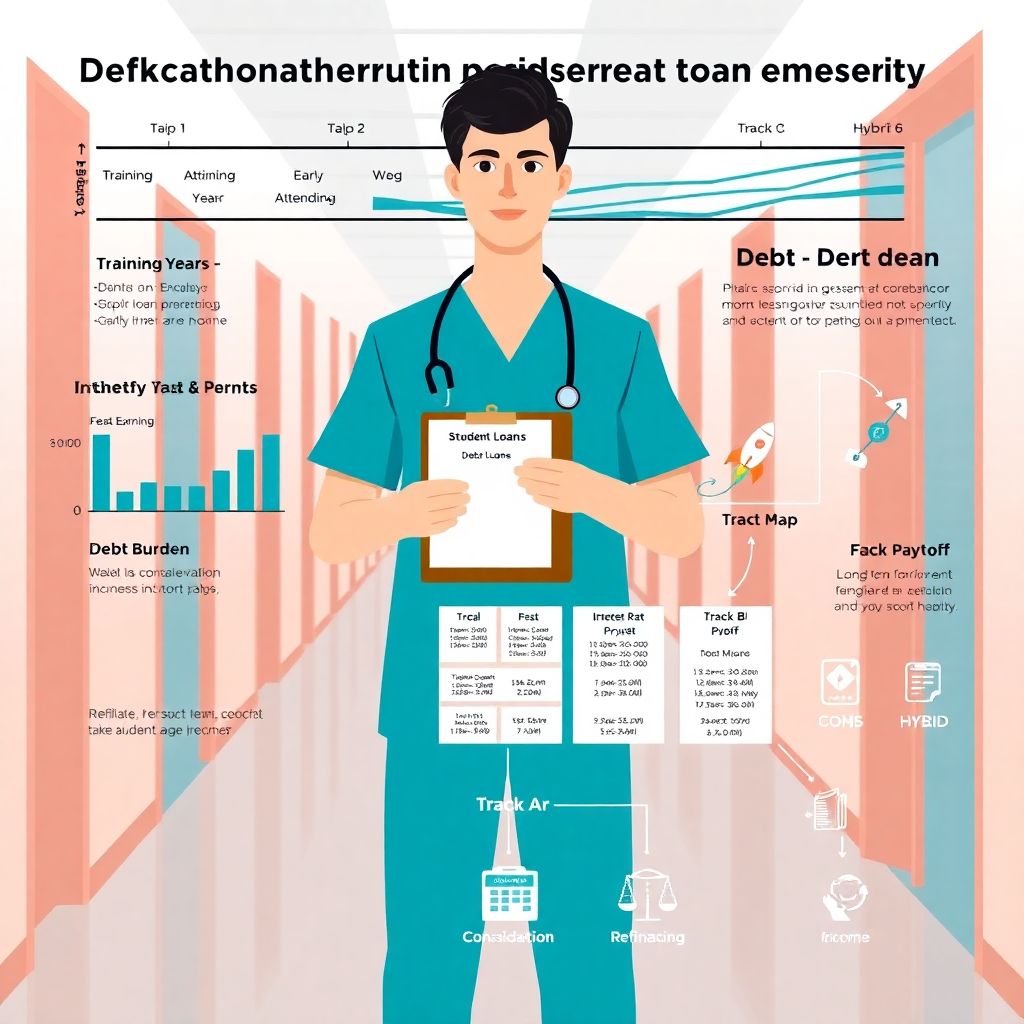
Why Debt Hits Healthcare Professionals So Hard
Debt reduction for healthcare professionals is its own special beast. You start earning later than your peers, you often live in expensive cities, and your first “real” salary arrives right when your student loans exit grace periods. That mismatch between income timing and loan repayment is the root of most frustration. To tackle it properly, you need a system that respects your irregular training path, your on‑call lifestyle, and the psychological weight of owing six figures before you’ve even bought decent furniture or considered a family.
Before we go further, let’s nail down a few core definitions you’ll need. “Principal” is the amount you actually borrowed; “interest” is the rent you pay to use that money. “Refinancing” means taking a new loan to pay off old ones, usually at a lower rate, while “consolidation” means merging multiple loans into one payment, not always with a better rate. The “debt‑to‑income ratio” (DTI) is the share of your gross monthly income that goes to debt payments; for clinicians, anything above 30–35% starts to squeeze career freedom and lifestyle choices.
Seeing Your Debt Like a Clinical Case
Think of your loans the way you think of a complex patient: you need diagnostics, staging, and then a treatment plan. Start with a “debt map”: list every loan, its balance, interest rate, monthly payment, and whether it’s federal or private. This is your financial chart. Now add context: current income, projected income in 3–5 years, and any big life events (fellowship, relocation, kids). That map turns panic into data. Pro tip: use one evening, not a whole weekend. This is like pre‑rounding, not writing a textbook; the goal is clarity, not perfection. Once the map is clear, you can choose between aggressive payoff, strategic forgiveness, or a hybrid approach.
Picture a simple diagram in your head:
[Income Timeline] → [Training Years | Early Attending | Peak Earning]
[Debt Burden] → [High | Moderate | Low]
Your job is to push the “Debt Burden” line downward faster than the “Income Timeline” goes up. Unlike most professionals, you know your income will likely jump in discrete steps (residency → attending → partnership). Your plan should sync major payoff moves with each jump, the same way you’d schedule a staged procedure instead of trying to fix everything in one risky marathon operation.
Key Terms Without the Jargon Fog
“Debt consolidation for doctors” usually refers to merging multiple federal and/or private loans into a single private loan with one interest rate and one payment. This simplifies your life but may sacrifice federal benefits. “Income‑driven repayment” (IDR) ties your payment to your income, not your balance. For healthcare workers in training, IDR often acts like a pressure‑relief valve, especially when combined with partial interest subsidies on some plans. “Student loan forgiveness for healthcare professionals” covers programs where, after a certain number of qualifying years in public, rural, or underserved roles, your remaining balance is wiped out—sometimes taxable, sometimes not.
Now a quick mental diagram of priorities:
Step 1: Protect benefits you might actually use (forgiveness, forbearance, flexible plans).
Step 2: Lower your interest cost without killing Step 1.
Step 3: Match payoff intensity to your career stage.
This hierarchy keeps you from reflexively refinancing everything just because your co‑resident did, or clinging to federal loans for 20 years when forgiveness clearly doesn’t fit your real career path.
Forgiveness, Refinancing, or Both?
Compare three main tracks. Track A: pursue forgiveness, such as public programs for clinicians in non‑profit hospitals or community health centers. You accept a longer repayment horizon with predictable, income‑based payments, often tolerable during residency and early attending years. Track B: commit to paying everything off fast with aggressive overpayments and, often, private refinancing to reduce interest. Track C: hybrid—start on forgiveness‑friendly plans while you’re uncertain, then pivot to payoff once your long‑term job reality settles. Each track has trade‑offs in flexibility, total cost, and psychological relief.
“Best refinancing options for medical school loans” become relevant when forgiveness is unlikely or impossible. But here’s the twist: instead of a one‑time “big bang” refinance, consider staged refinancing. First stage during late residency or fellowship when some lenders offer attending‑level rates based on signed contracts. Second stage once your credit profile and income are stronger. This staggered method can balance safety (keeping some federal benefits early) with savings (lower rates later). It’s similar to gradually de‑escalating therapy as you monitor patient response instead of making one giant, irreversible change.
Beyond PSLF: Lesser‑Known Relief Programs
Everyone talks about big federal programs, but many ignore targeted medical professional debt relief programs. States, hospital systems, and even specialty societies quietly fund loan repayment in exchange for specific commitments—rural coverage, night shifts, teaching, telehealth for underserved populations. These are often stackable with your normal salary, effectively acting as a guaranteed “return” on choosing a particular practice environment. Think of it as hazard pay aimed at your balance sheet instead of your paycheck.
Imagine a diagram that layers income streams:
Base salary
+ Shift differentials
+ Signing bonus
+ Loan‑repayment incentives
= Total financial package
Now add your debt payment below that. You’re not just comparing salary offers; you’re comparing how fast each offer destroys your principal. Sometimes a slightly lower salary with a strong loan repayment component is, in real terms, a higher‑value job, especially in the first decade of practice when compounding interest matters most.
Unconventional Tactics That Actually Fit Medical Life

Standard advice says “cut lattes, make a budget, live like a student.” You’ve probably heard that enough. Let’s explore a few non‑obvious tactics that fit a clinician’s unusual schedule. One powerful move is “locum‑tenens debt sprints.” For a defined 6–12 month period, take strategically chosen locums shifts or additional telemedicine sessions, and dedicate 80–100% of that side income directly to principal reduction. Because these shifts are temporary by design, they don’t permanently burn you out, yet they can erase years’ worth of scheduled payments if you treat them as a finite sprint.
Another unconventional tool is what you might call a “debt sinking fund with a release valve.” Instead of sending every spare dollar straight to your loan servicer, you set up a high‑yield savings or brokerage account dedicated only to future lump‑sum payments. You funnel a fixed percentage of each paycheck into it. Twice a year, you pause, check your emotional and professional state, and decide how much of that balance to throw at debt. This gives you psychological flexibility: if burnout is rising or a family emergency appears, you can redirect part of the fund without raiding your retirement or going into new credit‑card debt.
Using Business Thinking in a Personal Context
Most physicians and nurses forget that their medical degree is also a business asset. One tactical mindset shift: treat your early attending years as “startup phase.” In a startup, owners defer some lifestyle upgrades, keep fixed costs low, and reinvest aggressively. For you, that may mean deliberately capping housing and car expenses for the first five years of practice, then channeling the gap into principal reduction. This is not about austerity forever; it’s about a finite window of overperformance to gain freedom later, just like a startup sacrifices dividends early to dominate its market.
Here’s a conceptual diagram of cash flow:
[Gross Income]
→ [Mandatory costs: taxes, minimum loan payments, basic living]
→ [Flexible layer: housing upgrades, car, travel, childcare options]
→ [Strategic layer: extra debt payments, investing, down payment fund]
Instead of letting the flexible layer swell automatically with your first big raise, freeze it consciously for a defined period. Each extra dollar that flows to the strategic layer shrinks the compounding interest monster that quietly lives in your loan statements. This is less about strict budgeting apps and more about one or two decisive constraints that you maintain until specific, measurable milestones are hit.
Bringing Pros on Board—On Your Terms

Many clinicians are wary of advisers, often for good reason. The phrase “financial planning services for physicians” covers everything from high‑quality fiduciary planners to commission‑driven product sales. To use them effectively, treat a planner like a consultant on a complex case: you set the question, you demand evidence‑based reasoning, and you retain final decision‑making authority. Useful questions include: “Given my specialty and likely job trajectory, is forgiveness realistically optimal?” or “What’s the most tax‑efficient way to balance refinancing with retirement saving over the next five years?”
An underrated strategy is hiring a planner for a one‑time or hourly “case review,” not a lifetime relationship. You bring your complete debt map, current contracts, and goals; they build a written action plan you can execute on your own. That keeps costs contained and prevents you from outsourcing all thinking about money. In other words, you’re not asking someone to “handle it”; you’re asking for a second opinion on a treatment plan you intend to understand and manage yourself, the same way you’d consult a subspecialist without surrendering primary responsibility.
Psychology, Identity, and Sustainable Aggression

Debt isn’t just numbers; it’s identity‑shaping. Many clinicians carry a quiet sense of shame or “I should know better” about money, especially when their balances look huge compared with friends outside medicine. Reframe the situation: your debt is largely an investment in human capital with a long, productive lifespan. The problem isn’t that you borrowed; it’s how you now manage that leverage. A productive stance is: “I am using a high‑earning, high‑impact career to unwind a front‑loaded investment as efficiently as possible,” not “I made a mistake and must punish myself with deprivation.”
To keep aggression sustainable, set process‑based goals instead of only outcome‑based ones. Instead of saying “I must pay off $300k in seven years,” say “For the next 36 months, I commit to a fixed overpayment of X per month and two focused income sprints per year.” Then schedule regular “case reviews” with yourself, just as you would for a complex chronic patient: check progress, tweak the plan, adjust intensity based on new data. This clinical mindset prevents emotional yo‑yoing between extreme frugality and burnout‑driven overspending.
Pulling It All Together
You don’t need a perfect plan; you need a directional one that respects your specific career path. Start with a clear debt map and rough projection of where your income is headed. Decide whether forgiveness, aggressive payoff, or a hybrid strategy genuinely fits your likely jobs, not your imagined ideal. Explore medical professional debt relief programs at the state, employer, and specialty levels before locking yourself into pure private refinancing. Layer in at least one unconventional tactic—a locums sprint, a flexible sinking fund, or a defined “startup phase” of restrained lifestyle—so your approach matches the realities of clinical life.
Finally, remember that a high‑debt, high‑income career is essentially a leverage puzzle. You’ve already done the hard part: surviving organic chemistry, call nights, and actual human emergencies. Compared with that, mastering interest rates, repayment plans, and a few strategic diagrams is manageable. Treat your financial life with the same structured curiosity you bring to medicine, and your balance sheet will eventually catch up with the level of responsibility you carry every day at work.