
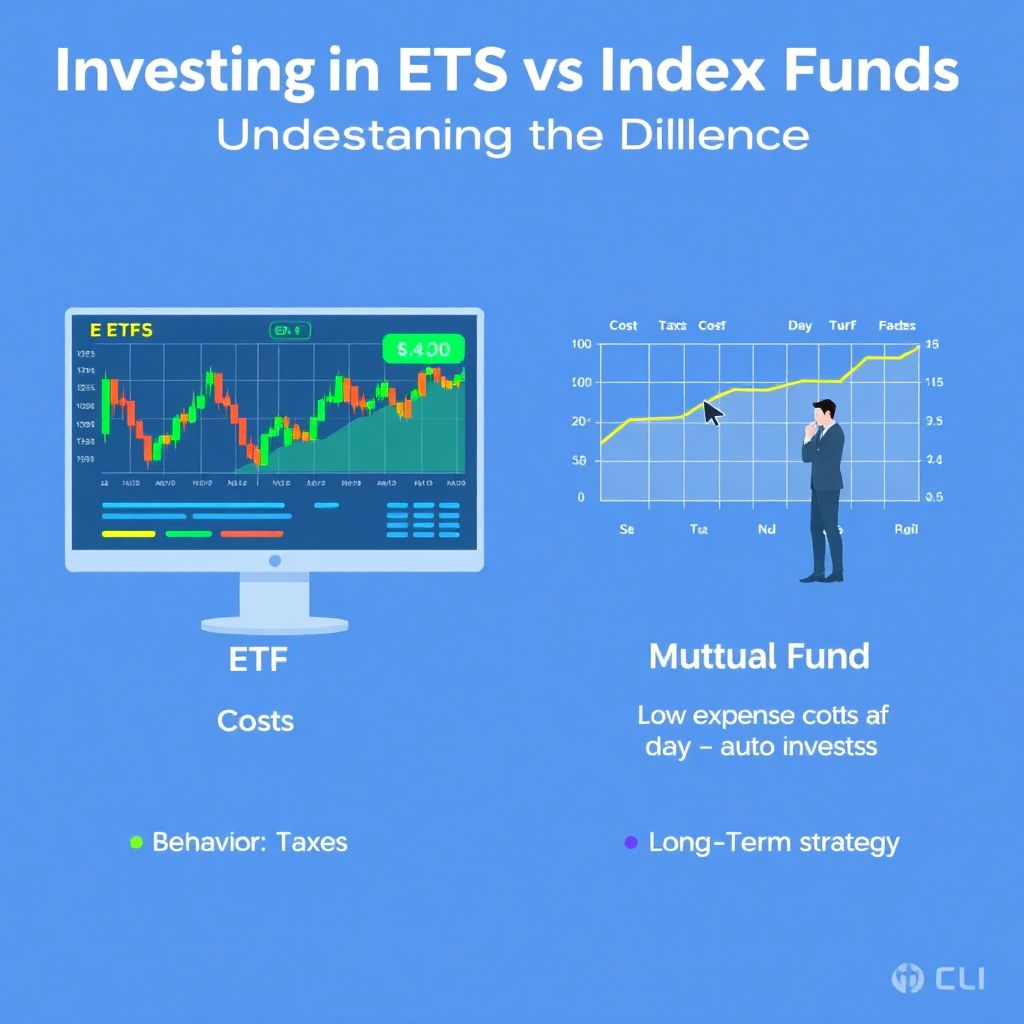
Investing in ETFs Versus Index Funds: Understanding the Difference
Why This Comparison Actually Matters
If you’re torn between ETFs and index funds, you’re already past the beginner “should I invest at all?” stage. Now the real question is: *what structure quietly steals (or saves) your money over the next 20–30 years?*
Both products often track the same indexes, hold similar baskets of stocks or bonds, and look almost identical from a distance. Yet the details—how you trade them, how they’re taxed, how you build habits around them—can produce very different real‑world results.
So instead of asking only “etf vs index fund which is better long term?”, it’s more useful to ask:
> *Which one fits my behavior, my tax situation, and my cash‑flow style?*
—
Historical Background: How We Got Two “Passive” Options
From Stock Picking to Owning the Whole Market
In the 1970s, index mutual funds appeared as a rebellion against expensive active management. Jack Bogle and Vanguard popularized the idea: stop trying to outsmart the market; just own it cheaply. That’s where classic S&P 500 index funds came from.
For decades, index mutual funds were the default “simple, boring, effective” approach. No day trading, no fancy structure—just automatic investment at the day’s closing price and low fees.
The Birth of ETFs: Same Idea, Different Wrapper
ETFs arrived in the early 1990s as a more flexible way to own an index. Same passive philosophy, but traded like a stock on an exchange. That unlocked:
– Intraday buying and selling
– The ability to use limit orders and stop orders
– Easy access via most brokerage platforms worldwide
Then came niche products—sector ETFs, factor ETFs, thematic ETFs—which blurred the line between “passive” and “active” inside the ETF wrapper. That’s where many investors started confusing the vehicle (ETF) with the strategy (indexing).
—
Basic Principles: What Actually Differs Under the Hood
How Index Mutual Funds Work
Index mutual funds are simple:
– You send money to the fund company or your broker.
– The order executes at the end‑of‑day net asset value (NAV).
– The fund manager adjusts holdings to match the index.
You can’t scalp prices during the day, but you get something underrated: frictionless behavior. You’re less tempted to trade constantly, which for most people is a feature, not a bug.
How ETFs Work in Practice
ETFs live on an exchange. You see a live price, place orders, and trade throughout the day. Underneath, an ecosystem of authorized participants and market makers keeps ETF prices close to the value of the underlying holdings.
This extra plumbing gives ETFs two main functional advantages:
– Flexible trading (intraday, limit orders, options, etc.)
– Usually better control of capital gains distributions through the in‑kind creation/redemption process
That second point is what powers the often‑cited etf vs index fund tax efficiency comparison in favor of ETFs, especially in taxable accounts in the U.S.
—
Behavior First: An Unconventional Way to Choose
Start Not with Products, but with Your Own Weak Spots
Instead of searching the internet for *best etfs vs index funds for beginners* as if there’s a universal winner, try this unusual approach: audit your own tendencies.
Ask yourself:
– Do I get anxious watching prices move all day?
– Do I like tinkering, or do I do better with guardrails?
– Am I maxing out tax‑advantaged accounts, or investing mostly in taxable ones?
Then match the product to your *likely behavior*, not just to theoretical performance. For many people, the right answer is:
– ETFs in taxable accounts (for flexibility and potential tax benefits)
– Index mutual funds in retirement accounts (for automatic investing and “out of sight, out of mind” simplicity)
A Simple Heuristic That Actually Works
Instead of obsessing about etf vs index fund which is better long term at a product level, use this three‑step rule:
– Want to automate paycheck‑to‑portfolio with minimal decisions?
→ Lean toward index mutual funds.
– Want to optimize taxes and trading precision in a brokerage account?
→ Lean toward ETFs.
– Already know you’re a chronic trader?
→ Consider deliberately banning intraday ETF trades and using funds that only trade at close.
—
Cost, Fees, and the Hidden Price of Flexibility
Why “Low Cost” Is Non‑Negotiable
Whether you pick ETFs or index funds, the core must be low cost etfs and index funds to invest in. Expense ratios compound just like returns—but in the wrong direction.
Look for:
– Expense ratios under ~0.15% for broad market exposure
– No (or very low) transaction fees through your broker
– Tight bid‑ask spreads for ETFs
The structural cost difference between a good ETF and a good index fund is often tiny. The bigger difference is whether you use that ETF structure to overtrade or stick to a plan.
The Quiet Drag of the Bid‑Ask Spread
ETFs introduce a subtle cost mutual funds don’t have: the spread between buy and sell prices. For big, liquid ETFs, that spread can be 0.01–0.05%—tiny but real. For niche products, it can be much higher.
If you’re dollar‑cost averaging small sums frequently, wide spreads can quietly erode returns. That’s one reason a plain index mutual fund at the same provider can actually beat a thinly traded ETF even with nearly identical stated fees.
—
Taxes: Where ETFs Usually Pull Ahead
The Structural Edge of Many ETFs
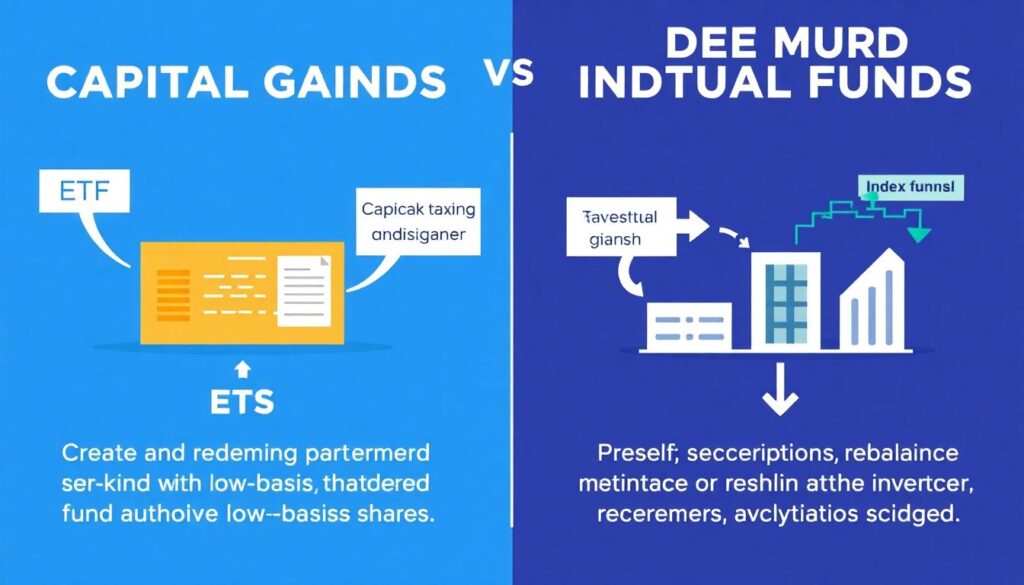
Because of how ETFs create and redeem shares (often in‑kind), they can offload low‑basis shares to authorized participants instead of realizing capital gains inside the fund. Index mutual funds usually have to sell securities for cash, triggering taxable gains when rebalancing or meeting redemptions.
Thus in a typical etf vs index fund tax efficiency comparison, ETFs come out ahead in taxable accounts, especially for U.S. investors in higher tax brackets.
When the Tax Edge Shrinks
The advantage narrows when:
– You’re investing in tax‑advantaged accounts (401(k), IRA, etc.)
– You choose very large, well‑managed index funds with low turnover
– Your country taxes funds differently than the U.S. system
An unconventional but practical move: in tax‑advantaged accounts, ignore the ETF vs fund tax debate entirely and optimize purely for automation, low fees, and behavior.
—
Practical Examples: How Real People Might Use Each
Example 1: The “Busy Professional” Setup
Profile: High income, little time, mostly using retirement accounts.
A smart, low‑maintenance setup could be:
– 401(k): broad index mutual funds for U.S. stocks, international stocks, and bonds
– IRA: same approach; auto‑invest every month at the fund level
This investor doesn’t need ETF bells and whistles. The right answer for them might be to treat how to choose between etfs and index mutual funds as trivial and focus instead on savings rate and allocation.
Example 2: The “Tax‑Aware” Investor
Profile: Maxes retirement accounts, also invests heavily in a taxable brokerage account.
A more nuanced system:
– 401(k)/IRA: index mutual funds (or ETFs) chosen for simplicity
– Taxable account: broad, low‑turnover stock ETFs to reduce annual capital gains distributions
– Use specific‑lot tax‑loss harvesting with ETFs when markets dip
Here, ETFs genuinely add value by pairing tax efficiency with flexible rebalancing.
Example 3: The “Optimization Addict” Who Needs Protection
Profile: Loves markets, constantly checking prices, high risk of overtrading.
Counterintuitive but effective plan:
– Use index mutual funds for the *core* portfolio to blunt the urge to trade
– If needed, allow a small “sandbox” ETF allocation (5–10%) for experimentation
– Set calendar‑based rebalancing only—no impulsive moves
Here ETFs become a pressure valve, and mutual funds become guardrails. That’s a behavioral answer to the etf vs index fund which is better long term question: whichever one you’re less likely to sabotage.
—
How to Choose Between ETFs and Index Mutual Funds in Real Life
A Decision Checklist That Isn’t Product‑Obsessed
When you’re figuring out how to choose between etfs and index mutual funds, use criteria beyond “what did someone on YouTube say?”:
Ask:
– Where is this money held—taxable account or tax‑advantaged?
– Do I value intraday trading or would I rather not see live quotes at all?
– Does my broker charge commissions on one but not the other?
– Do I want automatic investment straight from my paycheck?
– What’s my actual tax bracket and holding period horizon?
Then prioritize:
– Behavior and automation
– Total cost (expense ratio + spreads + commissions + tax drag)
– Simplicity of management over 10–30 years
A boring, consistent approach usually beats a complex, “optimized” one that you abandon in three years.
—
Common Misconceptions That Distort the Choice
Misconception 1: “ETFs Are Always Better Than Index Funds”
ETFs are not magically superior. They’re just a wrapper. For someone who wants simple automatic investing, index mutual funds can be a better fit even if they’re microscopically less tax‑efficient on paper.
Misconception 2: “Index Funds Can’t Be Tax Efficient”
Large, well‑run index funds can be very tax‑friendly, especially when they:
– Track broad, low‑turnover indexes
– Have steady inflows (so they don’t have to sell much to meet redemptions)
The real distinction is often between broad, low‑turnover strategies and high‑churn, niche products—regardless of whether they’re ETFs or mutual funds.
Misconception 3: “ETFs Encourage Day Trading, So They’re Bad”
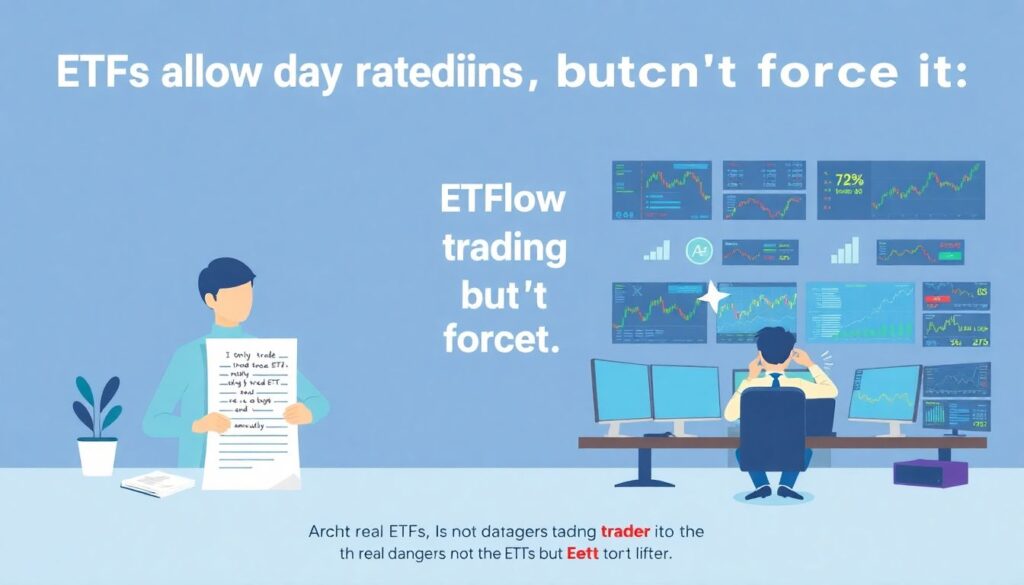
ETFs *allow* day trading, but don’t force it. Used with a written plan—“I only trade these broad ETFs monthly and rebalance annually”—they can be as disciplined as any index fund. The danger isn’t the ETF; it’s undisciplined behavior combined with 24/7 market access.
—
Nonstandard Strategies for Using Both Smartly
Strategy 1: Split by Account Type, Not Product Loyalty
Instead of dogmatically declaring loyalty to ETFs or funds:
– Use index mutual funds in employer plans and IRAs where they’re cheapest and easiest to automate.
– Use broad, tax‑efficient ETFs in taxable accounts for long‑term holdings.
You’re optimizing the system, not picking a team.
Strategy 2: A “Core as a Fund, Satellite as an ETF” Approach
Set up your portfolio like this:
– Core 80–90% in plain index mutual funds (global stocks + bonds)
– Satellite 10–20% in diversified, liquid ETFs (e.g., factor tilts, specific regions)
This keeps complexity contained. Your core is simple and boring; your satellites can be more tactical—but still rules‑based, not impulsive.
Strategy 3: Design for Your Future, Not Your Present Self
Assume your future self will be busier, more tired, and less interested in micromanaging investments. Build around that:
– Favor vehicles that still work when you stop paying close attention.
– Choose products you’d be comfortable leaving untouched for a decade.
– Treat low cost etfs and index funds to invest in as “default failsafes”, not tactical toys.
That mental model turns the ETF vs fund decision from a hobbyist debate into a tool for building a life where investing runs quietly in the background.
—
Pulling It Together
ETFs and index mutual funds are just two routes to the same destination: broad, low‑cost market exposure. For most investors, the “right” answer isn’t about which product wins a theoretical comparison, but which setup makes it easier to:
– Invest consistently
– Keep costs and taxes low
– Stay the course through volatility
If you align the wrapper (ETF or fund) with your behavior, tax situation, and account structure, you’ll be much closer to the real goal: a portfolio that quietly compounds while you get on with the rest of your life.