
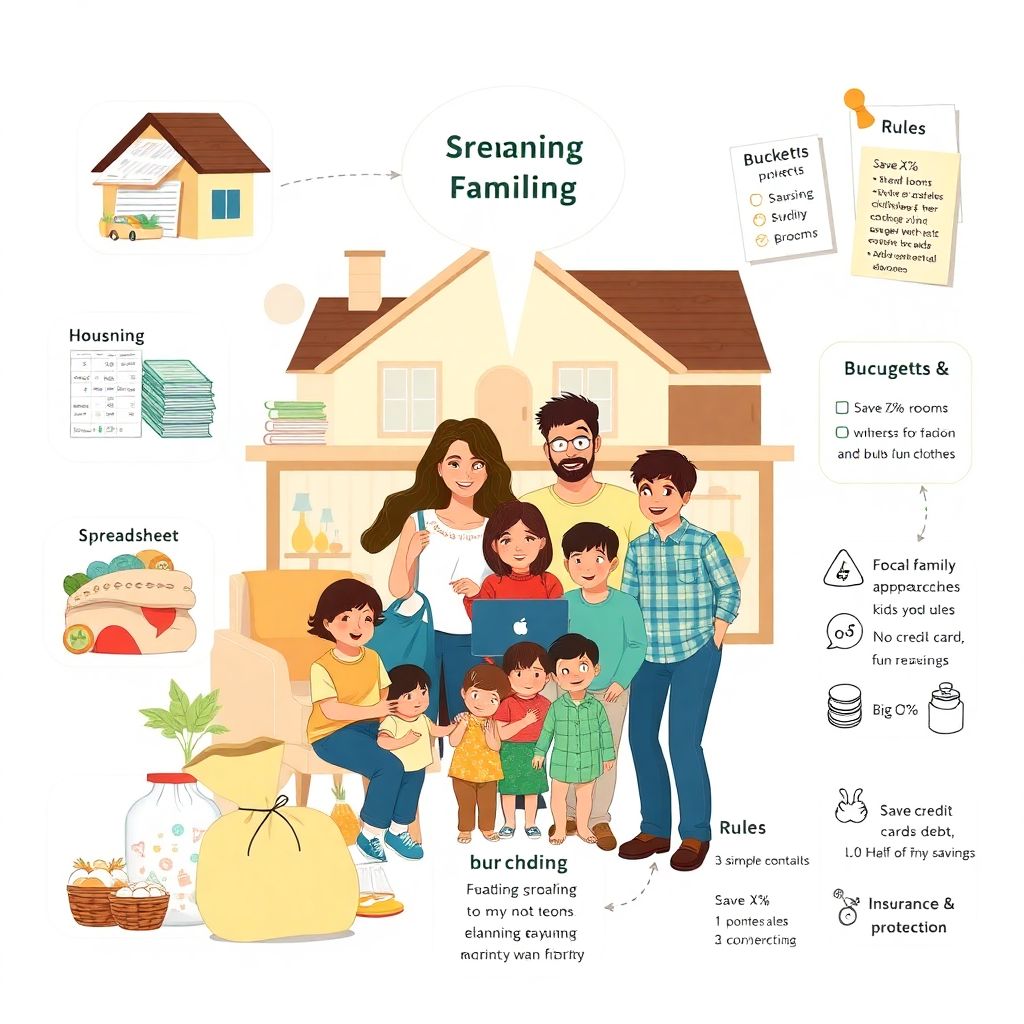
Why Financial Prep Matters When Your Family Is About to Get Bigger
Expanding your family from one child to three, or from none to twins, is not just a lifestyle choice; it’s a long‑term financial commitment that will stretch over 20–25 years. In the US, the USDA has estimated the cost of raising one child to adulthood at over $230,000 (before college), and inflation plus childcare costs have only pushed that number higher in the last decade. Other developed countries show similar trends: more expenses concentrated in childcare, housing and education.
So, financial planning for growing family life isn’t about perfection. It’s about building enough structure so surprises don’t knock you flat, and choosing the approach that fits how you actually live, not how a textbook family “should” live.
—
Step One: Get Clear on the Real Costs (Not the Instagram Version)
Major cost categories to expect
When you think “large family,” think in bundles of recurring costs, not just one‑off baby gear. Here’s where the bulk of the money usually goes:
– Housing (more rooms, bigger utility bills, higher rent or mortgage)
– Food (especially from age 11+ when appetites explode)
– Childcare and education
– Healthcare
– Transport (bigger car, more fuel, maintenance)
– Activities, clothes, tech, and “everything has to be multiplied by 3–4”
Economists project that, in many countries, childcare and education costs will continue to grow faster than general inflation, while electronics and some goods may stay relatively affordable. That means the long‑term pressure point for a large family is service‑based spending: daycare, healthcare, tutoring, and housing in good school districts.
Short-term vs long-term cost focus: two mindsets
There are two basic ways people approach this:
1. Short‑term, cash‑flow mindset
“Can we handle the next 12 months?” Focus on immediate daycare, diapers, maybe a minivan.
2. Long‑term, lifetime‑cost mindset
“What will this look like over 20 years?” Includes college, teens’ expenses, long‑term housing plans.
Neither is “wrong,” but:
– If you focus only on the short term, you may under‑save and over‑borrow later.
– If you obsess over the long term, you may over‑stress now and delay having kids you actually want.
The most effective approach for a large family tends to be a layered plan: nail the next 12–24 months in detail, then sketch the 5–20 year picture with flexible assumptions.
—
How to Budget for a Large Family: Three Practical Approaches
You don’t need a perfect spreadsheet. You need a system you’ll actually use. Let’s compare three common approaches to how to budget for a large family and what tends to work best.
1. The “Traditional Spreadsheet” Approach
This is the classic: detailed categories, projected costs, actual vs planned.
Pros:
– Very accurate if you keep it up to date
– Great visibility into where money leaks out
– Easy to run “what if” scenarios (e.g., “What if we add one more daycare day?”)
Cons:
– Time‑consuming; often one partner owns it and the other feels lost
– Easy to abandon the moment life gets chaotic (which it will)
Best for:
Analytical personalities, families with irregular income, or those planning very large expansions (3+ kids) where small percentage errors become big money over time.
2. The “Buckets” or Envelope Method
Instead of 40 budget categories, you use 5–8 big “buckets” (Housing, Food, Kids, Fun, Savings, etc.). Money is assigned by percentage or fixed amounts.
Pros:
– Fast and simple; easy to adjust as kids grow
– Easier to discuss as a couple (“We’re over in Kids; what do we cut?”)
Cons:
– Less granularity; you see that costs are up, but not always why
– Can hide slow cost creep (subscriptions, small upgrades)
Best for:
Busy parents, dual‑income households, and anyone who hates detailed tracking but is willing to adjust big levers once a month.
3. The “Rules-Only” Approach
Here you barely “budget” at all. You set a few rules and let them run:
– Save X% of income automatically
– Never carry a balance on credit cards
– Any raise: half to savings, half to lifestyle
– Child‑related expenses must fit in a pre‑set cap
Pros:
– Minimal time investment
– Works surprisingly well if rules are thoughtfully set early
Cons:
– Easy to set rules too low or too high
– Less control when big, one‑off costs hit (braces, private school, etc.)
Best for:
Families that hate budgeting and prefer guardrails. Works well if income is stable and you review the rules annually.
Which approach wins?
For most large families, a hybrid works best: buckets for simplicity, with a light spreadsheet for big‑ticket planning (housing, daycare, school, college).
—
Insurance: Protecting a Larger Crew
Best life insurance for families with kids
Once you have several dependents, your financial risk spikes. You’re no longer insuring a lifestyle; you’re insuring a whole ecosystem.
Comparing approaches:
– No or minimal life insurance
Works only if you have significant assets or another income source that can fully cover housing, childcare and education. High risk for most families.
– Employer‑provided only
Easy and cheap, but often only 1–2x salary. For a large family, many planners recommend at least 7–10x annual income in term life coverage, especially while kids are young.
– Custom term life policies
Usually the best life insurance for families with kids combines employer coverage plus personal term policies that last until the youngest child is through school or college.
Term life typically beats whole life for large families: lower premiums, clearer coverage. The “investment” component of whole life rarely outperforms simply buying term and investing the difference in a low‑cost index fund.
Family health insurance plans comparison: what actually matters
Healthcare is a major economic aspect of raising many children, and policy design is changing fast as insurers adapt to demographic shifts and rising medical costs.
When you do a family health insurance plans comparison, look past the monthly premium:
– Deductible and out‑of‑pocket maximum – For multiple kids, it’s very likely someone will hit the doctor often; a slightly higher premium with a lower max out‑of‑pocket can actually save you money.
– Network quality and pediatric coverage – Check which children’s hospitals and pediatric specialists are covered.
– Mental health and therapy benefits – Increasingly important, and usage is rising among teens.
Industry trend: insurers are moving toward more telehealth, digital tools and wellness incentives. For large families, this can cut both ways: you may save time and some costs, but must track which services are actually covered and which are “extras.”
—
Education and College: Multiplying the Big Ticket
College savings plans for multiple children
One child and one 529‑type plan? Easy. Four kids and rising tuition inflation? Different story.
You have three main strategies:
1. Equal individual accounts
Each child gets their own plan with roughly equal contributions.
– Clear and “fair”
– More admin, and someone may not go to college
2. One shared family account (where allowed)
You fund a single account and later assign funds where needed.
– More flexible if kids choose different paths
– Requires clear communication to avoid “you love them more” drama
3. Hybrid approach
Some base amount for each child plus a shared “top‑up” fund.
Given uncertainty about future tuition and the growth of online and alternative education, a shared or hybrid structure often works best for college savings plans for multiple children. It’s more adaptable to changes in:
– Tuition inflation
– Scholarship opportunities
– Kids’ actual interests (trade schools, coding bootcamps, etc.)
From an economic‑forecast standpoint, most analysts expect education costs to keep rising faster than general inflation, but with more price pressure from online programs and demographic shifts (fewer college‑age students in some regions). Translation: plan as if traditional college will remain expensive, but stay flexible.
—
Daily Money Management with a Large Family
Where big families actually save (and where they don’t)
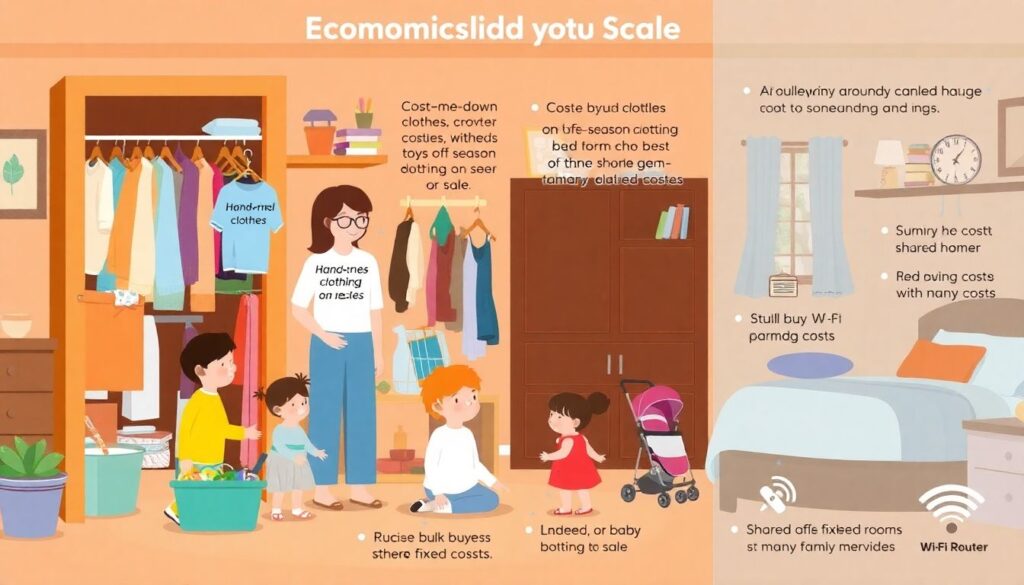
Economies of scale sound nice: bulk buying, hand‑me‑downs, shared rooms. They help, but they don’t fully offset the total increase in costs.
Areas where large families often do save:
– Clothing (hand‑me‑downs, buying off‑season)
– Toys and gear (strollers, cribs reused)
– Some fixed costs (internet, streaming, car insurance spread over more people)
Areas where costs scale up fast:
– Groceries, especially fresh produce and protein
– Transport (bigger car, more frequent replacement)
– Activities and hobbies (sports, music lessons, trips)
– Time: less of it, leading to more convenience spending
To keep daily life manageable, combine structural choices with habits:
– Live below what the bank says you can afford for housing
– Choose schools and activities with an eye on commute time and “hidden” costs
– Automate bills, savings and investments so daily chaos doesn’t derail long‑term plans
—
Short List: Setting Up a Financial Base Before the Baby Boom
Core moves to make 6–12 months before expanding
– Build a 3–6 month emergency fund (aim for the higher end with multiple kids).
– Pay down high‑interest debt aggressively.
– Price out upgraded housing and transport realistically; don’t assume your current costs scale linearly.
– Adjust your life and health insurance to reflect the new number of dependents.
– Decide on your budgeting approach (spreadsheet, buckets, or rules) and test‑run it for a few months.
—
How a Growing Family Affects the Broader Economy and Industry
Large families are not just a private choice—they shift demand patterns across entire industries.
– Housing: Demand for multi‑bedroom rentals and suburban homes rises. Developers and city planners respond with more family‑oriented neighborhoods, but often with longer commutes.
– Healthcare: Pediatric clinics, telehealth platforms and children’s hospitals expand services. Insurers redesign products to capture multi‑child households.
– Consumer goods: Brands move toward economy sizes, subscription models (diapers, formula), and loyalty programs targeting parents.
– Education and childcare: More pressure on daycare capacity, after‑school programs and tutoring services—many areas already face shortages, pushing prices up.
Over the next decade, demographic projections in many developed countries show slower overall population growth but relatively stable or rising numbers of children in certain corridors (fast‑growing suburbs, migrant‑rich regions). Businesses are betting on more value‑driven, convenience‑heavy offerings: think bundled services (childcare plus activities), all‑in‑one family memberships, and app‑based cost management tools.
For you, this means two things:
– More choice, but also more complexity in offers and pricing
– More opportunities to optimize—if you’re willing to compare and negotiate
—
Putting It All Together: Pick an Approach That Matches Your Reality
To prepare financially for a large family expansion, you don’t need a perfect plan; you need a workable one that fits your habits:
– If you like precision: build a detailed plan with a spreadsheet backbone and strict savings rules.
– If you’re time‑poor: use bucket budgeting and automation, revisiting the big picture twice a year.
– If you hate numbers: set a few non‑negotiable rules (savings %, insurance coverage, debt limits) and keep lifestyle creep in check.
Whichever route you choose, anchor it on three pillars:
– Protection – solid insurance and an emergency fund
– Predictability – a clear budgeting system and conscious housing choices
– Flexibility – education and long‑term goals planned with multiple futures in mind
Your family doesn’t have to look like a financial spreadsheet. But if the money side is reasonably under control, you’ll have more room for the messy, noisy, unforgettable parts of having a big crew under one roof.