
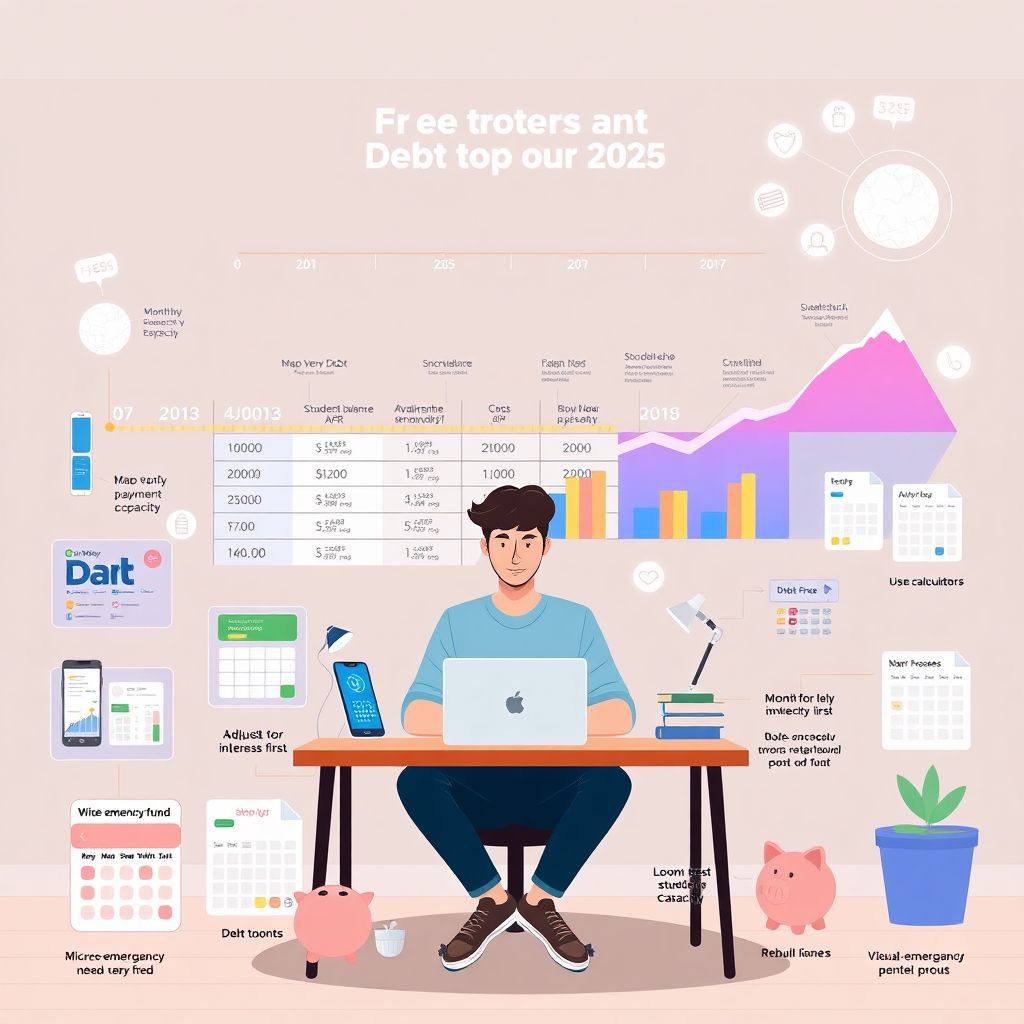
Why a Realistic Debt Repayment Timeline Matters in 2025
Debt isn’t new. Ancient Mesopotamians carved IOUs into clay tablets. Medieval Europe had moneylenders long before banks. After World War II, credit cards appeared and reshaped consumer life. Then the 2008 crisis reminded everyone what happens when debt gets out of control.
Fast‑forward to 2025:
– Digital banks issue instant credit lines
– “Buy Now, Pay Later” is everywhere
– Student loans and credit cards are a normal part of adult life
Yet one thing hasn’t changed: people still underestimate how long it takes to get out of debt — and overestimate their willpower.
That’s why you need a realistic debt repayment timeline, not a wishful one. Let’s walk through, step by step, how to build a plan that fits your real life instead of some spreadsheet fantasy.
—
Step 1: Map Every Single Debt (No Guessing)
Write down what you actually owe
You can’t build a timeline if you don’t know the starting point. Open all your accounts — not from memory, but from statements or apps.
List for each debt:
– Type (credit card, student loan, car, personal loan, BNPL, etc.)
– Current balance
– Interest rate (APR)
– Minimum monthly payment
– Due date
– Whether it has any special rules (intro 0% APR, variable rate, penalties)
If it feels messy, that’s normal. Modern credit systems are designed to be easy to open and hard to track.
Separate “good” structure from “bad” behavior
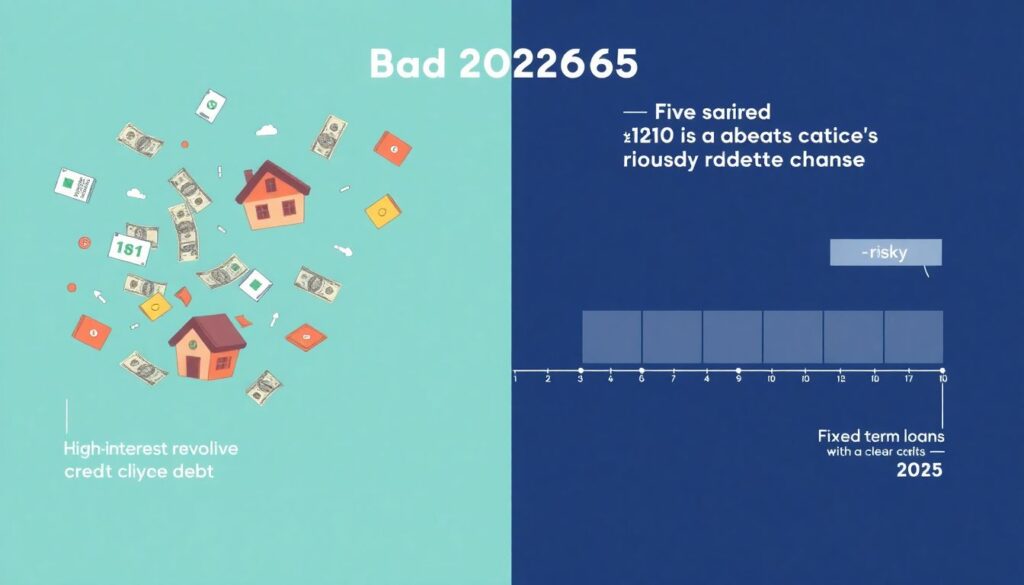
The old idea of “good debt vs bad debt” (like mortgages = good, credit cards = bad) is oversimplified. In 2025, what matters more is whether the structure of the debt helps or traps you:
– High-interest, revolving credit (most credit cards) = risky
– Fixed-term, clear payoff date loans = easier to plan around
– Variable rate loans in a rising interest environment = red flag
Your timeline will mostly focus on the debts that grow the fastest if you ignore them.
—
Step 2: Get Your Realistic Monthly Number
Figure out what you can truly afford for debt
Forget “I’ll just stop going out and put $1,000 a month on debt” if you’ve never done it before. You need a number that survives bad days, surprise bills, and low-motivation weeks.
1. Write down your average net income per month (after tax).
2. List your non-negotiable essentials:
– Rent / mortgage
– Utilities
– Basic groceries
– Transport to work
– Insurance and essential meds
3. Add realistic amounts (not idealized) for:
– Phone + internet
– Basic social life (you won’t cut it to zero for years)
– Occasional clothes / household items
Whatever is left is your maximum available for debt.
Now be strict:
– Take that number
– Subtract 10–20% as a buffer
The result is your actual monthly debt payment capacity. This is the foundation of a realistic timeline.
Micro‑emergency fund comes first
If you have zero savings, divert at least a small amount (even $25–$50 per month) into a micro‑emergency fund before going all‑in on debt. Historically, people fall back into debt not because the plan is bad but because the first car repair or vet bill nukes the progress.
—
Step 3: Choose Your Payoff Strategy (With Eyes Open)
Since the 1980s, financial advisors have argued about the best strategies to pay off credit card debt. In 2025, the main contenders are still the same — just with fancier apps.
Debt avalanche vs snowball (and consolidation)
You’ll often hear debates like debt consolidation vs debt snowball. Let’s break down the real-world version.
– Debt avalanche
– Pay minimums on all debts
– Throw extra money at the highest interest rate first
– Mathematically fastest and cheapest
– Requires emotional discipline (you might not see quick wins)
– Debt snowball
– Pay minimums on all debts
– Throw extra money at the smallest balance first
– Quick psychological wins and visible progress
– May cost more in total interest
– Debt consolidation
– Rolling multiple debts into a single new loan (personal loan or 0% balance transfer)
– Can simplify payments and lower your rate
– But only helps if you stop adding new debt and the fees/rates make sense
In practice, most people use a hybrid: they start with a snowball for motivation, then pivot toward an avalanche style as they gain momentum.
—
Step 4: Use Tools Without Letting Them Lie to You
Run the numbers (but adjust for real life)
Online tools can speed things up. A debt repayment plan calculator can show you:
– How long it will take to become debt‑free
– How much interest you’ll pay
– How different monthly payment amounts change the timeline
But calculators assume you always pay the same amount on the same day without ever being human. To keep it realistic:
– Add a couple of months buffer to whatever payoff date the calculator gives you
– Assume some months you’ll only hit the minimum
– Recalculate any time your income changes or you add/clear a debt
Historic pattern: people consistently overestimate what they can commit monthly. Your job is to be the exception.
—
Step 5: Build Your Actual Debt Payoff Timeline
Turn theory into dates and milestones
Now we translate ideas into calendar reality. This is where you actually decide how to create a debt payoff timeline that works month by month.
Use this simple structure:
1. List debts in the order you’ll tackle them (snowball, avalanche, or hybrid).
2. Decide your monthly total for all debt payments.
3. For each debt, estimate:
– Start month (when you begin paying extra)
– Expected “paid off by” month
4. Add 1–3 “flex months” per year for life happening.
Sample logic (not exact math, just structure)
1. Months 1–3: Pay minimums + extra on Credit Card A (smallest balance).
2. Months 4–9: Card A is gone; roll that payment onto Card B (highest interest).
3. Months 10–18: Target personal loan with combined payment power.
4. Months 19–24: Shift to student loan or car loan.
Each time you pay off a debt, you do not lower your total monthly amount. You just redirect it. That’s the heart of every effective payoff strategy.
—
Step 6: Make Space for “How to Pay Off Debt Fast” Without Burning Out
Speed is good, but sustainability wins
Everyone wants to know how to pay off debt fast, especially when interest rates are high and prices keep climbing. But “fast” doesn’t mean “miserable to the point you quit.”
Use speed‑boosters that are realistic for you:
– Negotiate lower interest rates or hardship plans
– Move high-interest card debt to a lower-rate product (if you’re disciplined)
– Add temporary extra income bursts:
– Seasonal work
– Freelance gigs
– Selling unused stuff
– Cut temporary expenses:
– Subscriptions you won’t miss after a month
– One or two recurring “autopilot” expenses you forgot about
Then decide in advance:
– What % of any bonus, tax refund, or side income goes automatically to debt? (e.g., 70%)
This keeps the payoff timeline aggressive without depending on willpower alone.
—
Step 7: Write Down Rules for When Life Happens
Protect your timeline from chaos
History shows that debt spikes around big shocks: oil crises in the 1970s, the 2008 crash, the 2020 pandemic. On a personal level, your “shock” might be:
– Job loss
– Medical issue
– Family emergency
– Breakup or divorce
You can’t predict events, but you can define rules.
Numbered rules you can use:
1. If income drops by more than 20%, I:
– Pause extra payments
– Keep minimums only
– Protect a small emergency buffer
2. When income recovers for 3 straight months, I:
– Restart the full debt payment amount
– Recalculate the timeline
3. If I need to use a credit card for survival:
– I track that separately
– I avoid adding new non-essential purchases
4. Every 6 months, I:
– Update balances
– Check interest rates
– Adjust target payoff dates
By deciding these rules before you’re stressed, you’re less likely to panic and abandon the plan.
—
Step 8: Keep Motivation Alive Over a Multi‑Year Journey
Long timelines need emotional fuel
In the 1950s, most consumer debts were shorter and simpler. In 2025, multi‑year student loans and layered credit cards are normal. That means your timeline might be 3, 5, or even 10 years.
To stay in the game:
– Track progress visually:
– Debt thermometer on your wall
– Spreadsheet you update monthly
– App that shows total balance dropping
– Celebrate strategic milestones:
– First card paid off
– First time total debt drops below a round number
– First month you hit your planned payment for 6 months straight
– Connect the payoff to something bigger:
– Freedom to change jobs
– Ability to move cities or countries
– Starting a family or business
Motivation doesn’t appear magically. You build it like you build the plan — deliberately.
—
Step 9: Rebuild Your Financial Life Around Less Debt
Don’t let history repeat itself
If you look at the last 50 years, household debt has tended to creep up during good times. People feel safer, borrow more, and then get hit when the cycle turns.
When your repayment timeline is underway — or nearing the end — start shifting focus:
– Build a proper emergency fund (3–6 months of basic expenses)
– Automate savings for future big goals (education, house, business)
– Keep credit card usage intentional:
– Use them for rewards only if you pay in full monthly
– Reduce available limits if they tempt you
– Periodically review old habits that led to debt:
– Impulse shopping
– Emotional spending
– Lack of price comparison or negotiation
Your timeline isn’t just about deleting numbers. It’s about rewriting how money flows through your life.
—
Final Thoughts: Your Timeline Is a Living Document
A realistic debt repayment timeline isn’t a rigid contract. It’s a living plan that responds to your income, your health, and the economy.
To recap the essentials:
– Know every detail of your debts
– Set a monthly amount you can truly maintain
– Choose a strategy (or hybrid) that fits your brain, not just a formula
– Use tools like a debt repayment plan calculator, but adjust for real life
– Add buffers and written rules for when life hits
– Review and update the timeline at least twice a year
Debt has been part of human history for thousands of years. What’s different now is that you have more data, more tools, and more flexibility than any generation before you.
Use them to build a payoff timeline that doesn’t just look good on paper — it actually gets you to the day you make your last payment and don’t have to start over again.