
Why 529 Plans Matter More Than Ever
College isn’t getting cheaper, and that’s exactly why a 529 plan deserves serious attention. According to the College Board, average published tuition and fees at four‑year public colleges rose about 5% in nominal terms between 2022–23 and 2024–25, while room and board crept up another 4–6%. Over the same period, data from the College Savings Plans Network show that total assets in 529 savings plans grew from roughly $430 billion in early 2022 to about $470 billion by late 2024. Families are clearly voting with their wallets. A 529 doesn’t just stash cash; it wraps your savings in tax advantages and flexible rules that can keep options open if your child’s plans change.
What a 529 Plan Actually Is (Plain-English Definition)
A 529 plan is a tax‑advantaged investment account designed for education costs, sponsored by a state or, in some cases, an educational institution. You put after‑tax money in, invest it, and the growth is tax‑free if the money is later used for qualified education expenses like tuition, fees, and often room and board. The key idea: instead of saving in a normal brokerage account where dividends and capital gains can trigger annual taxes, 529 earnings stay sheltered. That’s why discussions about the best 529 plans for college savings focus on low fees, flexible rules, and a solid investment lineup, not just on basic interest rates or gimmicky bonuses.
Tax Benefits and How They Work for Parents
The core 529 plan tax benefits for parents are threefold: tax‑deferred growth, tax‑free withdrawals for qualified expenses, and potential state tax breaks. At the federal level, you don’t deduct contributions, but you also don’t pay federal tax on growth if you use funds correctly. Over 30 states plus D.C. offer a deduction or credit on contributions, usually limited by an annual cap per beneficiary. Between 2022 and 2024, several states modestly raised these caps to keep pace with inflation, subtly improving the deal. The catch: non‑qualified withdrawals trigger income tax on the earnings plus a 10% federal penalty, so planning matters. For many households, the combination of tax‑free compounding and state incentives beats using a regular taxable account.
How Money Flows Through a 529 (Text Diagram)
Think of a 529 as a simple pipeline for education funding. In text‑diagram form, the flow looks like this:
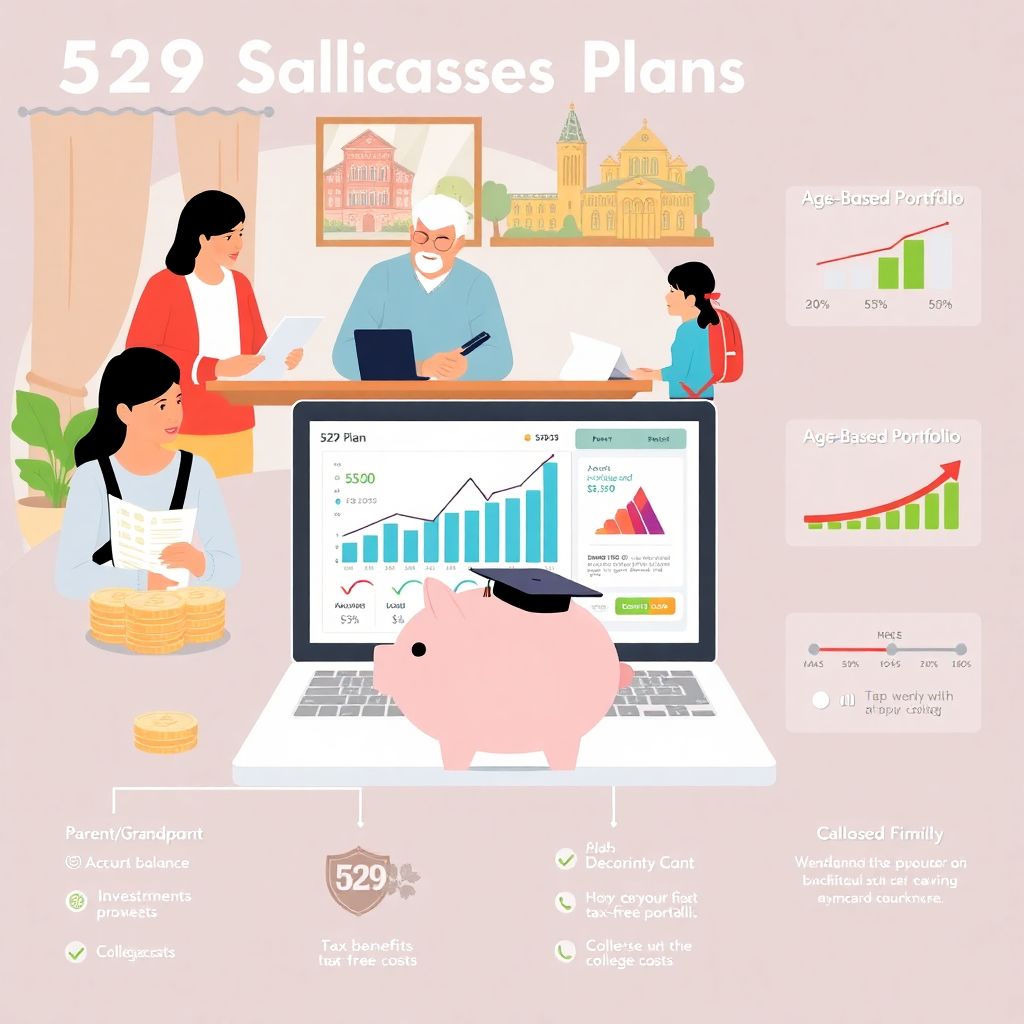
Parent/Grandparent ➝ (Contributes after‑tax dollars) ➝ 529 Plan Account ➝ (Invests in chosen portfolio) ➝ Tax‑free growth over years ➝ (Withdrawals) ➝ College or other qualified education costs. Within that pipeline, the account owner controls the valves: they decide how much to contribute, which 529 plan investment options and returns profile to use, and when to pull money out. Beneficiaries can be changed to another family member if needed. This structure explains why 529 plans remain popular: the owner stays in charge, the beneficiary can change, and the tax treatment is usually better than in custodial UGMA/UTMA accounts.
Investment Options, Age-Based Tracks and Returns
Inside a 529, you don’t buy individual stocks directly; you pick from menus of portfolios. Most plans offer three broad categories: age‑based tracks that automatically shift from stocks toward bonds and cash as college nears, static risk‑level portfolios (conservative, moderate, aggressive), and sometimes individual fund options. From 2022 to 2024, market volatility was substantial, but many age‑based 529 portfolios still delivered mid‑single‑digit annualized returns over three years, depending on equity exposure and fees. The real power comes from compounding: even a 5–7% average return over 15–18 years can meaningfully shrink your child’s need for student loans. When you compare 529 college savings plans, focus on net performance after fees, not just headline returns.
- Age‑based portfolios: “set it and forget it” glide path, higher stock share when kids are young.
- Static portfolios: you pick a risk level and it stays constant over time.
- Capital preservation options: stable value or money market‑style choices for near‑term withdrawals.
Comparing 529 Plans Across States
You’re not locked into your home state’s plan, which is why it’s smart to compare 529 college savings plans rather than defaulting automatically. The main levers are: fees (both administrative and fund costs), state tax breaks, investment depth, and user experience. For instance, some states with strong tax incentives but higher fees might still be worth using for contributions up to the deductible limit, while you invest additional amounts in a low‑cost out‑of‑state plan. Between 2022 and 2024, several states trimmed expense ratios or added index funds, narrowing the gap between the very best 529 plans for college savings and the rest of the pack. The practical move is to weigh your state’s tax perk in dollars against any extra annual fees you’d pay.
Opening and Funding a 529 in Practice

If you’re wondering how to open a 529 plan online, the mechanics are straightforward. You visit the plan’s website, create an account as the owner, name your child (or yourself) as beneficiary, and connect a bank account. Identity checks are similar to opening a brokerage account. Within 15–30 minutes, most people are done with the setup. Contributions can be one‑off transfers, automated monthly deposits, or even payroll deductions when employers support them. Since 2022, many plans have enhanced online dashboards, mobile apps, and e‑sign workflows, making recurring contributions easier to set up. Even modest automatic transfers—say $50–$100 per month—can accumulate to tens of thousands of dollars over 15–18 years when combined with steady investment returns.
- Automate contributions to avoid “forgetting” to save during hectic months.
- Align deposits with paydays so savings happen before money is spent elsewhere.
- Ask relatives to gift directly into the 529 for birthdays or holidays.
Realistic Examples and Recent Trends

Consider a family that started a 529 in 2022 with $3,000 and has contributed $200 per month since. With a hypothetical 6% annual return, by early 2025 their balance could be around $10,000–$11,000, depending on exact timing and market swings. That’s already a solid chunk of one year’s tuition at an in‑state public university. Zooming out, participation has also shifted: CSPN data show the number of 529 accounts rising from roughly 15.5 million in 2022 to about 16.5 million in 2024, while average account size inched up from around $27,000 to nearly $29,000. The trend line is clear: more families are using 529s earlier, treating them as a long‑term, core part of paying for post‑secondary education rather than a last‑minute fix.
529 vs Other Ways to Save for College
A 529 is powerful, but it’s not the only tool. Compared with a Roth IRA, a 529 is usually better for education‑specific savings because it avoids the tug‑of‑war with retirement needs and offers clearer tax treatment for tuition. Against custodial UGMA/UTMA accounts, 529s keep control with the adult, not the child, and they don’t automatically convert to the student’s asset at age 18 or 21. That control can matter for financial aid calculations and for avoiding impulsive spending. Regular taxable brokerage accounts win on total flexibility but lose on taxes; annual dividends and realized gains are usually taxable. In practice, many families pair a 529 with a small, flexible brokerage account to cover potential non‑education goals while maximizing the education‑specific tax edge.