
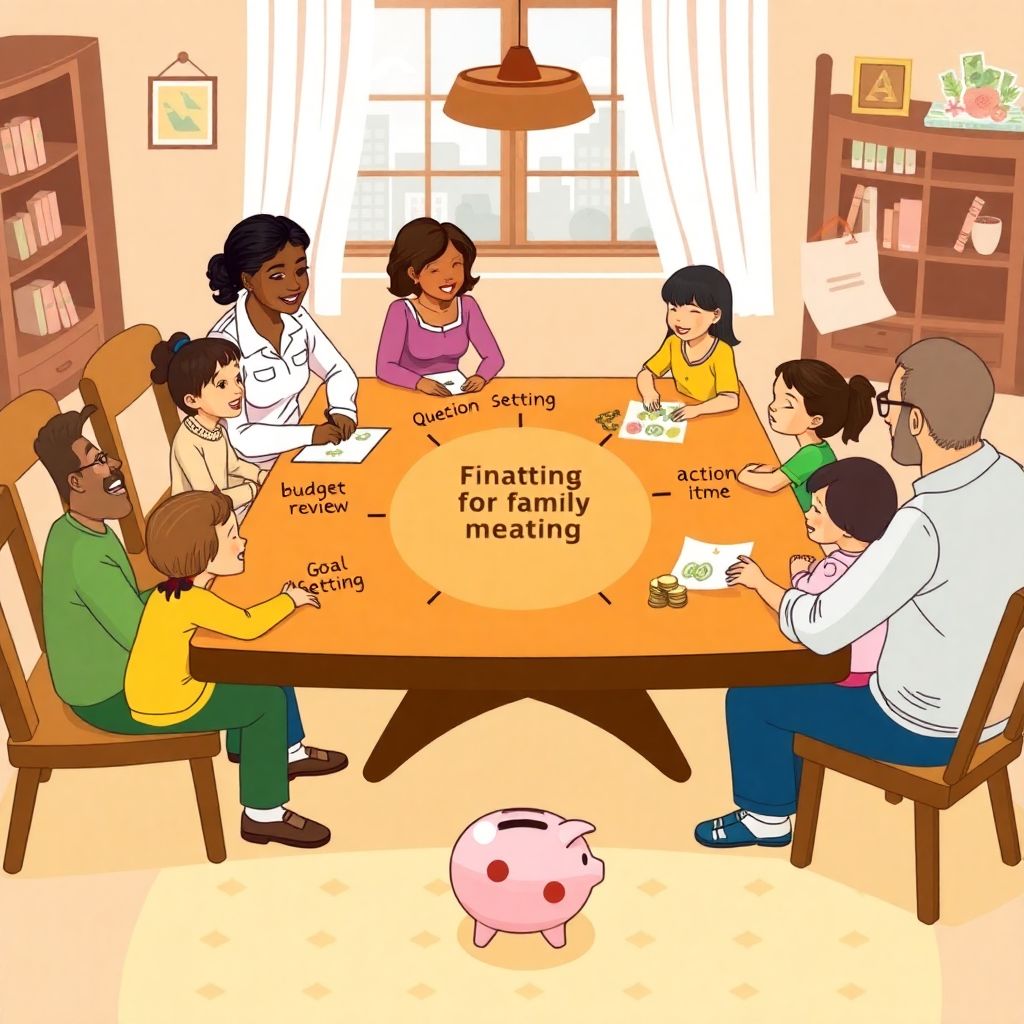
The Role of Family Meetings in Financial Education
Understanding Family Meetings in Financial Context
A *family meeting* is a structured, regular gathering where household members discuss shared topics, such as schedules, responsibilities, and increasingly—finances. When applied to money discussions, these meetings become a cornerstone for early financial literacy. They provide a safe, consistent space for children to ask questions, understand budgeting, and develop a healthy relationship with money from a young age. Financial literacy, in this context, refers to the knowledge and skills necessary to make informed and effective financial decisions.
Data from the 2023 T. Rowe Price Parents, Kids & Money Survey shows that 57% of parents avoid discussing money with their children due to discomfort or lack of knowledge. However, families who hold monthly meetings report a 34% higher rate of their children correctly identifying key financial concepts such as interest, savings, and budgeting.
Diagram: Structure of a Financial Family Meeting
Imagine a circular diagram representing the structure of a typical family money meeting. At the center is the “Core Topic” (e.g., allowance, saving for a family vacation). Surrounding it are four segments:
– Budget Review
– Goal Setting
– Question Time
– Action Items
Each segment builds upon the previous one. For example, reviewing the family budget helps children understand constraints, which makes discussions about goals more grounded in reality.
Why Family Meetings Outperform Informal Conversations

Unlike impromptu chats about money during grocery shopping or car rides, structured family meetings offer consistency and depth. They allow for better preparation from both parents and children and reduce the emotional charge often associated with financial stress. According to a 2022 Fidelity report, children who participated in routine family finance meetings were 42% more likely to save part of their allowance versus those who only had sporadic financial discussions.
Comparison: Family Meetings vs. Financial Apps for Kids
In recent years, digital tools like Greenlight or GoHenry have gained popularity for teaching kids about money. While these apps offer hands-on experiences with spending and saving, they lack the interpersonal component of family meetings. These apps are valuable supplements but cannot fully replace the context-setting and emotional engagement that a family meeting provides.
Key differences include:
– Emotional context: Family meetings allow values and emotions to be discussed alongside numbers.
– Flexibility: Meetings can address current family-specific topics (e.g., job loss, holidays).
– Feedback loop: Real-time discussion allows for misconceptions to be corrected immediately.
Best Practices for Conducting Effective Money Discussions
Age-Appropriate Financial Topics
Tailoring money conversations based on developmental stages is essential. For example, a six-year-old can grasp the concept of saving for a toy, while a teenager can understand compound interest and credit. The Consumer Financial Protection Bureau (CFPB) recommends introducing complex financial behaviors gradually, reinforcing them with real-life examples.
Examples:
– Ages 5–9: Identifying coins, saving in a piggy bank
– Ages 10–13: Understanding needs vs. wants, setting short-term goals
– Ages 14–18: Creating budgets, discussing credit and debt
Marrying Transparency with Boundaries

Parents often struggle with how much financial information to disclose. Full transparency can overwhelm children, while too little can foster ignorance. Experts suggest a middle ground—sharing enough context to explain decisions without burdening them with adult stress.
For instance, saying “We’re saving for a vacation, so we’re cutting back on dining out,” provides a cause-and-effect lesson in budgeting. Avoid phrases like “We’re broke,” which may induce anxiety without offering understanding.
Checklist for a Productive Family Finance Meeting
Before each meeting, set a clear agenda and encourage participation across age groups. Use visuals like a chart or jar system to explain abstract concepts.
Consider the following checklist:
– Review past goals and progress
– Discuss current financial topics (e.g., school supplies, birthdays)
– Allow each child to ask a question or share an idea
– Assign small responsibilities (e.g., tracking grocery receipts)
Conclusion: Long-Term Benefits of Financial Dialogue
Incorporating regular money discussions into family life builds not only financial literacy but also confidence and critical thinking in children. According to the 2024 Junior Achievement/Allianz Life study, 71% of teens who engaged in family finance meetings felt “prepared” to manage money independently, compared to only 38% of their peers who did not.
Family meetings, when conducted intentionally, become more than logistical check-ins—they evolve into a platform for generational knowledge transfer, fostering autonomy and resilience. As financial landscapes grow increasingly complex, early and consistent family dialogue is one of the most effective tools for building future-ready money managers.